BOM Extraction from Engineering Drawings: A Guide for Indian Manufacturers and EPC Companies
India's manufacturing and EPC sector runs on engineering drawings. Whether it is a process plant in Gujarat, a pharmaceutical facility in Hyderabad, a steel fabrication shop in Chennai, or a panel manufacturer in Pune — the bill of materials (BOM) is extracted from drawings, and it is almost always done manually.
An engineer opens a drawing — a P&ID, a general arrangement, a fabrication detail, or an assembly drawing — reads every tag, every callout, every specification note, and types the information into a spreadsheet. For a mid-size project with 200–500 engineering drawings, this process takes weeks and employs a team of 3–5 people working full-time.
The errors are predictable: missed items, transposed quantities, wrong specifications, and inconsistencies between the BOM and the drawing. By the time these errors surface — during procurement, fabrication, or site installation — they have already generated rework, delay, and cost overruns.
AI-powered BOM extraction is changing this. This guide covers how it works, why it matters specifically for Indian manufacturers and EPC companies, and what to expect when implementing it.
What BOM Extraction Involves
The Drawings
BOM extraction is not a single task — it varies by drawing type:
| Drawing Type | What Gets Extracted |
|---|---|
| P&ID (Piping & Instrumentation Diagram) | Instruments, valves, equipment, pipe specs by line number |
| General Arrangement (GA) | Equipment with dimensions, weights, and specifications |
| Isometric Drawings | Pipe spools with cut lengths, fittings, flanges, gaskets |
| Fabrication Details | Steel sections, plates with dimensions and quantities |
| Electrical Schematics | Components: contactors, relays, MCBs, terminal blocks |
| Panel Layouts | Components mounted inside panels with specifications |
| Assembly Drawings | Sub-components with part numbers, quantities, and materials |
Each drawing type uses different conventions for presenting BOM information. Some include explicit BOM tables on the drawing. Others encode the information in tag callouts, line numbers, and specification notes that must be interpreted.
The Manual Process
For most Indian engineering firms, BOM extraction follows this workflow:
- Engineer receives approved-for-construction (AFC) drawings
- Opens each drawing in AutoCAD, PDF viewer, or printed format
- Identifies every tagged component
- Looks up specifications from the tag number or drawing notes
- Enters item, quantity, specification, and material into an Excel BOM
- Cross-references with the equipment list, valve list, or instrument list
- Senior engineer reviews for completeness
This process is repeated for every drawing. For a petrochemical plant with 300 P&IDs and 1,000 isometric drawings, the total BOM extraction effort can run into thousands of person-hours.
Why Indian Manufacturing and EPC Need Better BOM Extraction
Scale of the Problem
India's EPC and manufacturing sector is enormous:
- $180+ billion EPC market with major players (L&T, BHEL, Thermax, Tata Projects, and hundreds of mid-tier firms)
- Hundreds of thousands of engineering drawings produced annually across process, power, steel, pharma, and oil & gas sectors
- Government initiatives like Make in India and PLI schemes driving manufacturing capacity expansion
- Export fabrication for international projects requiring strict BOM accuracy for customs and compliance
The common thread: every project starts with drawings, and every drawing contains material data that must be extracted into a structured BOM for procurement, fabrication, and installation.
The Cost of Errors
BOM errors in Indian manufacturing have specific consequences:
- Procurement delays — ordering the wrong specification or quantity delays material arrival by 4–8 weeks for imported items
- Fabrication rework — a missed fitting on an isometric drawing means the pipe spool must be re-fabricated
- Site rework — mismatched components discovered during installation require emergency procurement at premium cost
- Customs issues — for export projects, BOM discrepancies create customs clearance problems at destination ports
Industry estimates put the cost of BOM errors at 3–8% of total project material cost. For a INR 100 crore project, that is INR 3–8 crore in waste, rework, and delay costs.
How AI BOM Extraction Works
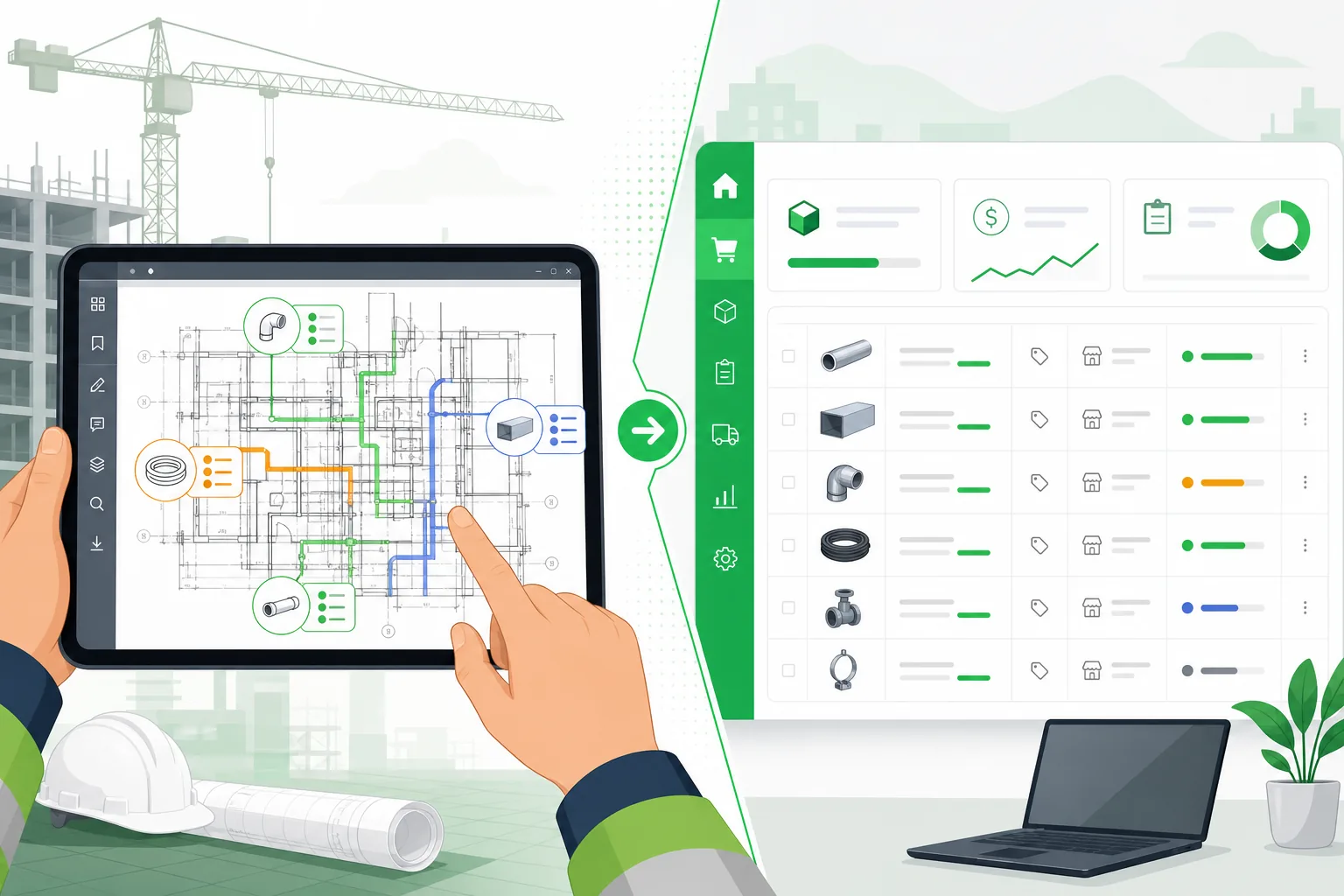
AI-powered BOM extraction uses computer vision and language models to read engineering drawings and extract structured material data automatically.
The Technology
The system works differently depending on the drawing type:
For P&IDs and Schematics: The AI identifies tagged components (instruments, valves, equipment) by recognizing symbols and reading associated tag numbers and specifications. It understands that a symbol with tag "FV-101" is a flow control valve, that the connected line "6'-P-CS-1001-A1A" specifies a 6-inch carbon steel pipe, and that the instrument bubble "FT-101" is a flow transmitter.
For Tabular Drawings (Panel Layouts, Assembly BOMs): The AI reads structured tables embedded in drawings — component lists, part tables, and BOM tables — extracting item descriptions, quantities, specifications, and manufacturer references.
For Isometric Drawings: The AI identifies pipe spools with their components: pipe lengths, elbows, tees, reducers, flanges, gaskets, bolts — each with size, material, and schedule specifications.
For Fabrication Details: The AI reads steel section callouts, plate dimensions, and weld specifications, compiling a material list by section type and grade.
What Makes It Different From Generic AI
A general-purpose AI model — even a very capable one — can describe what it sees on a drawing. But it cannot reliably extract structured BOM data because it does not understand engineering drawing conventions.
Purpose-built BOM extraction uses specialized models that understand:
- Tag numbering conventions (ISA standards for instruments, project-specific for equipment)
- Line specification codes (size, material, schedule, insulation class encoded in a line number)
- Symbol libraries specific to P&ID, electrical, and fabrication drawings
- Drawing-type-specific extraction rules (what to extract from a P&ID versus an isometric versus a GA)
This specialization is what makes the extraction reliable enough for engineering use. A system trained specifically on P&IDs knows that a diamond symbol is an instrument, not a decorative element, and that the text inside it is a tag number that maps to a specification.
Accuracy and Validation
AI BOM extraction typically achieves:
- 90–95% accuracy on clean, CAD-generated drawings with standard conventions
- 80–90% accuracy on scanned or legacy drawings
- 70–85% accuracy on drawings with non-standard conventions or heavy annotations
The review workflow is critical: the system highlights low-confidence extractions, flags items where specifications could not be fully resolved, and presents the drawing alongside the extracted BOM for rapid visual validation.
Practical Implementation for Indian Firms
Where to Start
-
Pick a drawing type — start with the type that consumes the most extraction hours. For process companies, this is usually P&IDs or isometrics. For electrical panel manufacturers, it is schematics and panel layouts. For fabrication shops, it is structural details.
-
Test with recent drawings — upload a completed project's drawings and compare the AI BOM with your manual BOM. This gives you a realistic accuracy baseline.
-
Measure the time savings — track how long the AI extraction + review takes versus the full manual process. Most firms see 70–85% time reduction on the extraction step.
Integration with Existing Workflow
AI BOM extraction replaces the extraction step, not the entire engineering workflow:
- Input: Same engineering drawings your team already works from
- Output: Structured BOM in Excel or CSV, formatted for your procurement or ERP system
- Review: Engineer validates the extracted BOM against drawings (reviewing, not re-creating)
- Downstream: BOM feeds into procurement, fabrication planning, and site installation tracking
The existing engineering judgment — deciding what to order, from which vendor, at what lead time — remains with your team. The AI eliminates the hours of manual data transcription that currently precede that judgment.
ROI for Indian Firms
| Firm Type | Typical Monthly Drawing Volume | Manual BOM Hours | AI + Review Hours | Monthly Savings |
|---|---|---|---|---|
| Mid-tier EPC | 500–1,000 drawings | 400–800 hrs | 80–160 hrs | 320–640 hrs |
| Panel Manufacturer | 100–300 drawings | 100–300 hrs | 20–60 hrs | 80–240 hrs |
| Fabrication Shop | 200–500 drawings | 200–400 hrs | 40–80 hrs | 160–320 hrs |
| Process Engineering | 300–600 drawings | 300–600 hrs | 60–120 hrs | 240–480 hrs |
At an average fully loaded cost of INR 600–1,000/hour for an experienced design engineer, the monthly savings range from INR 2–6 lakhs for smaller firms to INR 20–60 lakhs for mid-tier EPC companies.
The Competitive Advantage
Indian manufacturing and EPC companies are competing globally — bidding on projects in the Middle East, Africa, Southeast Asia, and Central Asia. Speed and accuracy in BOM preparation directly impact:
- Bid competitiveness — faster, more accurate estimates win more contracts
- Project delivery — fewer BOM errors mean fewer procurement delays and less rework
- Quality reputation — accurate BOMs reduce site issues that damage client relationships
- Margin protection — eliminating material errors protects the 8–12% margins that Indian EPC firms typically operate on
The firms that adopt AI BOM extraction in 2026 will have a structural advantage in throughput and accuracy that compounds with every project.
Aginera extracts BOMs from P&IDs, schematics, fabrication details, and panel layouts. Upload your engineering drawings and get a structured bill of materials in minutes. Try it free.