MEP Estimation for Indian Contractors: Tools, Templates, and AI That Actually Works
India's MEP contracting landscape operates at a scale and speed that is unique globally. A mid-tier M&E contractor in Mumbai, Bengaluru, or Delhi NCR might receive 10–15 tender invitations per month from a mix of government agencies, private developers, and EPC companies. Each tender comes with 100–400 pages of drawings, a 50-page specification document referencing IS codes and project-specific requirements, and a submission deadline that is almost always too soon.
The contractors who win consistently are not necessarily the ones with the lowest rates. They are the ones who can prepare accurate estimates fast enough to respond to every viable opportunity. This guide covers the tools, methods, and emerging AI platforms that Indian MEP contractors are using to solve the estimation bottleneck.
The Indian MEP Estimation Workflow
What a Typical Tender Cycle Looks Like
- Tender notification — NIT received via government portal (CPPP, GeM, state PWD), private developer invitation, or EPC subcontract inquiry
- Document collection — download drawings, specifications, BOQ format, general conditions, special conditions, and corrigenda
- Scope review — identify which MEP trades are included (HVAC, electrical, plumbing, fire fighting, ELV), what is in your scope, and what interfaces with other contractors
- Quantity takeoff — extract material quantities from drawings for each discipline
- Rate analysis — prepare unit rates from DSOR, vendor quotations, labour rates, and overheads
- BOQ preparation — compile quantities and rates into the client's prescribed BOQ format
- Internal review — senior estimator or director reviews for completeness and competitiveness
- Submission — physical submission (still common for government) or e-tender upload
The bottleneck is almost always step 4: the takeoff. It consumes 60–70% of the total estimation time and is entirely manual for most Indian firms.
Current Tools Used by Indian MEP Contractors
Microsoft Excel
Excel remains the default estimating tool for 80%+ of Indian MEP contractors. Firms maintain their own templates — some sophisticated with linked sheets, rate databases, and formula-driven summaries; others simple item-by-item lists.
What it does well: Flexible, familiar, and the output format most clients accept. Works for rate analysis and BOQ formatting.
Where it fails: Zero automation for the takeoff itself. Everything is manual data entry.
AutoCAD / DWG Viewers
Many estimators work with AutoCAD or free DWG viewers to measure from drawings. The area measurement and distance tools help with duct runs, pipe lengths, and room areas.
What it does well: Accurate measurement when done carefully. Allows snapping to drawing geometry.
Where it fails: Still manual identification and counting. No intelligence about what each element is.
CPWD Rate Analysis Software
Several Indian software vendors sell rate analysis tools aligned with CPWD/state PWD rate structures. These help calculate unit rates from first principles (material + labour + overheads) per CPWD methodology.
What it does well: Streamlines rate calculation for government project formats.
Where it fails: Only covers the pricing side. Does nothing for quantity extraction.
Cloud-Based Takeoff Tools
Some firms have adopted international takeoff tools for the measurement workflow. These offer PDF annotation, scale-based measurement, and quantity tracking.
What it does well: Faster than pure manual counting. Organized quantity tracking.
Where it fails: Still requires manual scanning of every symbol on every page. Not adapted to Indian BOQ formats or IS code conventions.
Where Indian MEP Firms Lose the Most Time
Through working with contractors across India, these are the consistent patterns:
1. HVAC Ductwork Measurement
Measuring duct runs from HVAC layout plans is the single most time-consuming MEP takeoff task. Each duct section has different dimensions, and the estimator needs linear meters by size for fabrication pricing. On a large commercial project, ductwork measurement alone can take 2–3 days.
2. Multi-Discipline Coordination
Indian MEP tenders often bundle mechanical, electrical, plumbing, and fire fighting under one contractor. The estimating team needs to do four separate takeoffs from four sets of drawings, often with different consultants and different drawing conventions for each discipline.
3. BOQ Reformatting
Government BOQ formats (CPWD sub-heads, state PWD item numbers) require specific descriptions and measurement conventions. Converting raw takeoff quantities into the prescribed format is tedious and error-prone. Private developers often provide their own templates that require similar reformatting.
4. Revision Cycles
Indian projects frequently issue revised drawings after the initial tender. Corrigenda may add or modify dozens of sheets. The estimator must identify what changed and re-measure those areas — or, more commonly, redo the entire takeoff because tracking sheet-level changes manually is impractical.
5. Multiple Vendor Quotations
Indian contractors typically collect quotations from 3–5 vendors per material category (Havells, Polycab, Finolex for cables; Blue Star, Carrier, Daikin for HVAC equipment). Managing these quotations and applying the best rates per item adds significant time to the estimation process.
How AI Changes MEP Estimation for Indian Contractors
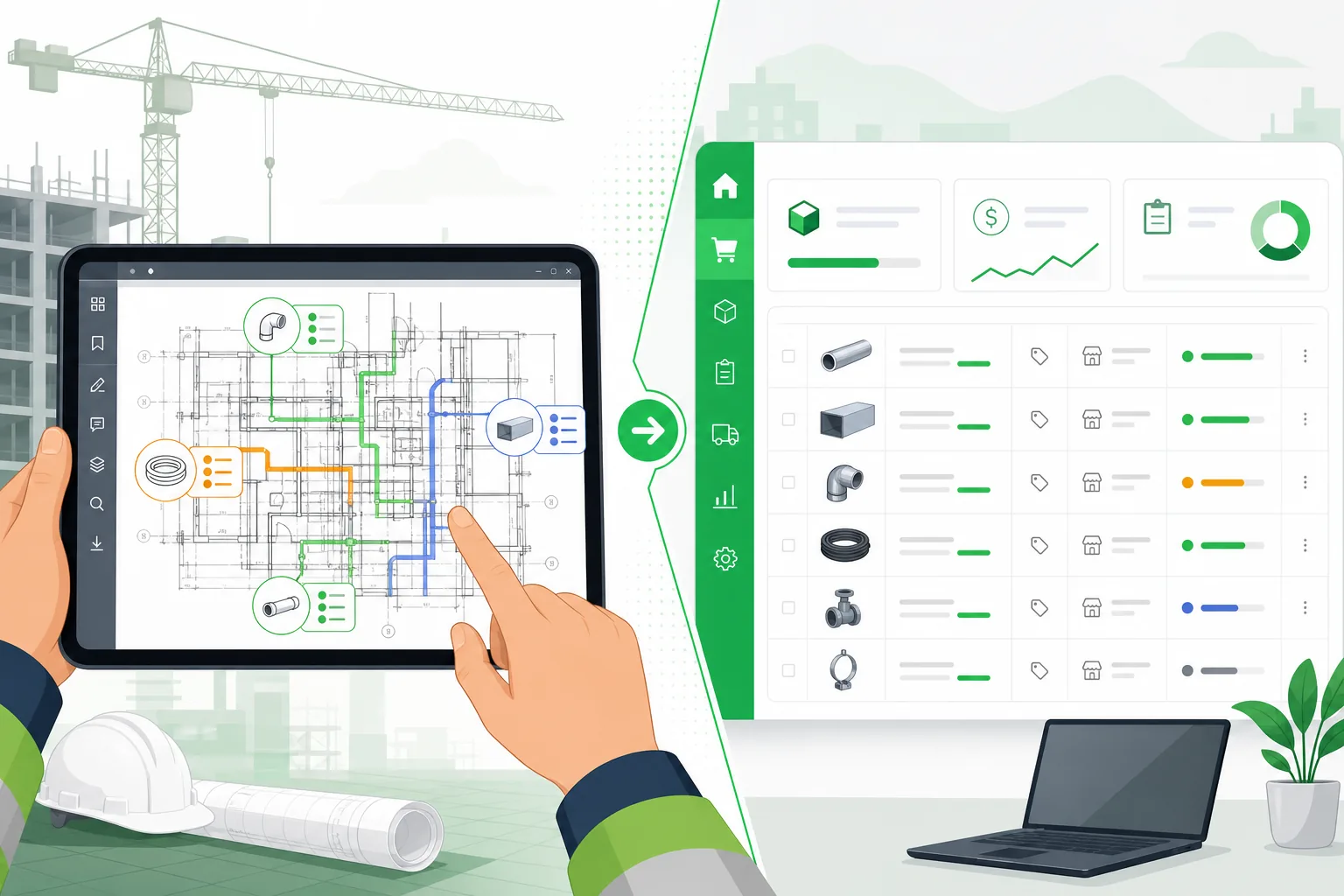
AI-powered takeoff platforms address the core bottleneck: automating the quantity extraction from drawings. Here is how the workflow changes:
Traditional Flow (5–7 days)
Drawing review → Manual counting/measuring per discipline → Excel compilation → Rate application → BOQ formatting → Review → Submit
AI-Assisted Flow (4–8 hours)
Upload drawings → AI classifies pages by discipline → AI extracts quantities per drawing type → Estimator reviews and corrects → Rate application → Export to BOQ format → Submit
The critical shift: the estimator moves from being a counter to being a reviewer. Their expertise applies where it matters most — judging whether quantities make sense, identifying scope gaps, and making pricing decisions — instead of spending days on symbol counting and measurement.
What AI Handles for Each Discipline
Mechanical (HVAC)
- Equipment identification from mechanical plans (AHUs, FCUs, VAV boxes)
- Duct run measurement by size from layout plans
- Pipe run identification from piping drawings
- Diffuser and grille counting from ceiling plans
Electrical
- Device counting from power and lighting layouts (switches, sockets, luminaires)
- Panel schedule extraction with circuit details
- Cable tray and conduit measurement
- Fire alarm and ELV device counting
Plumbing
- Fixture counting from plumbing layouts
- Pipe run measurement by diameter and material
- Equipment identification (pumps, heaters, treatment systems)
Fire Fighting
- Sprinkler head counting from suppression layouts
- Pipe network measurement
- Fire hydrant, hose reel, and extinguisher counting
The Business Case for Indian MEP Firms
The economics are straightforward:
Time Savings
A firm that bids 8 projects per month with an average of 3 estimator-days per bid currently spends 24 estimator-days per month on takeoffs alone. With AI reducing takeoff time by 80%, that drops to roughly 5 estimator-days — freeing 19 days for additional bids, proposal quality improvement, or value engineering.
Bid Volume Increase
At current capacity, firms leave 50–60% of viable tenders unbid. With AI takeoff, the same team can respond to 2–3x more opportunities. At a 20% win rate and an average contract value of INR 10 crore, each additional win adds INR 10 crore in revenue.
Accuracy Improvement
Manual takeoffs carry a 5–15% error rate depending on drawing complexity and estimator experience. Missed items, double-counts, and measurement errors all reduce margin. AI extraction with human review reduces errors to the 2–5% range — primarily on items that require judgment rather than counting.
Competitive Advantage
In a market where most competitors still estimate manually, the contractor who can respond to every tender with an accurate estimate — while others are still counting symbols — has a structural advantage in win rate.
Practical Advice for Indian MEP Firms
Start Small
Pick one discipline (electrical tends to be easiest) and one recent project. Upload the drawings to an AI platform and compare the output with your manual takeoff. This gives you a realistic picture of accuracy and time savings for your specific drawing types.
Keep Your Rate Database
AI automates the takeoff, not the pricing. Your DSOR rates, vendor relationships, and historical rate analysis remain valuable. The best workflow uses AI for quantity extraction and your existing rate database for pricing.
Train Your Team on Review, Not Data Entry
The skill shift is from "accurate counting" to "efficient reviewing." Train estimators to quickly validate AI output against drawings rather than building quantities from scratch. This is a different skill — faster, higher-level, and more engaging.
Use Revision Processing
The biggest ongoing time savings come from revision handling. When corrigenda arrive, upload only the changed sheets and let the AI update quantities. This turns a 2-day re-work into a 30-minute review.
The Path Forward for Indian MEP
India's construction pipeline is only accelerating. The Smart Cities Mission, metro expansion, data center construction, and commercial real estate development mean more tenders, larger projects, and tighter timelines for every MEP contractor.
The firms that will capture the most market share are those that can estimate at scale — responding to more opportunities, with higher accuracy, in less time. AI-powered MEP estimation is the most direct path to that capability, and 2026 is the year it has become practical enough for real Indian construction workflows.
Aginera handles all MEP disciplines from a single upload — mechanical, electrical, plumbing, and fire fighting. Built for the drawing types and bid volumes Indian contractors deal with every day. Try it free or book a demo.