How Aginera's AI Quality Agent Is Changing Electrical Takeoffs Forever
If you've ever spent a full day counting receptacles, tracing conduit runs, and cross-referencing panel schedules only to find a mistake at bid time — you know the pain.
Electrical estimating is the most labor-intensive discipline in construction takeoff. It's not just counting devices. It's knowing the conduit type, sizing the wire, tracing the circuit back to the panel, checking code compliance, and making sure nothing was missed across 40 or 50 electrical sheets. One missed circuit, one wrong conduit size, and your bid is either too high (you lose the job) or too low (you lose money).
Today we're rolling out three features that fundamentally change how electrical takeoffs work: automated conduit run inference, NEC/NFPA code compliance audits, and our most ambitious addition yet — a self-improving AI Quality Agent that checks, corrects, and learns from every extraction it touches.
Here's what they do, how they work, and why they matter for your next bid.
What Estimators Actually Need (and What Most Tools Miss)
Most takeoff software stops at device counting. Upload a drawing, get a list: 89 receptacles, 247 light fixtures, 12 smoke detectors. That's helpful, but it's maybe 25% of what you actually need to write a bid.
The other 75% is the hard part:
- What size conduit runs from the panel to those receptacles?
- How many feet of #12 THWN-2 do you need for Circuit 3?
- Where do you need junction boxes because the bends exceed 360 degrees?
- Does the design actually comply with NEC code?
- Did anything get missed on page 37?
These are the questions that consume an estimator's day. They require domain knowledge, code familiarity, and careful attention across dozens of sheets. Until now, no AI tool seriously attempted them.

Feature 1: Automated Conduit Run Inference
The Problem
Counting light fixtures is straightforward. Figuring out conduit runs is not.
An electrical estimator needs to trace each branch circuit from the panel to the last device, determine the conduit type (EMT, rigid, PVC, flex), size it based on the number and gauge of conductors inside, calculate the total run length, and add junction boxes wherever cumulative bends hit 360 degrees. Multiply that by 30 or 40 circuits per panel, and you're looking at hours of work per drawing set.
How Aginera Does It
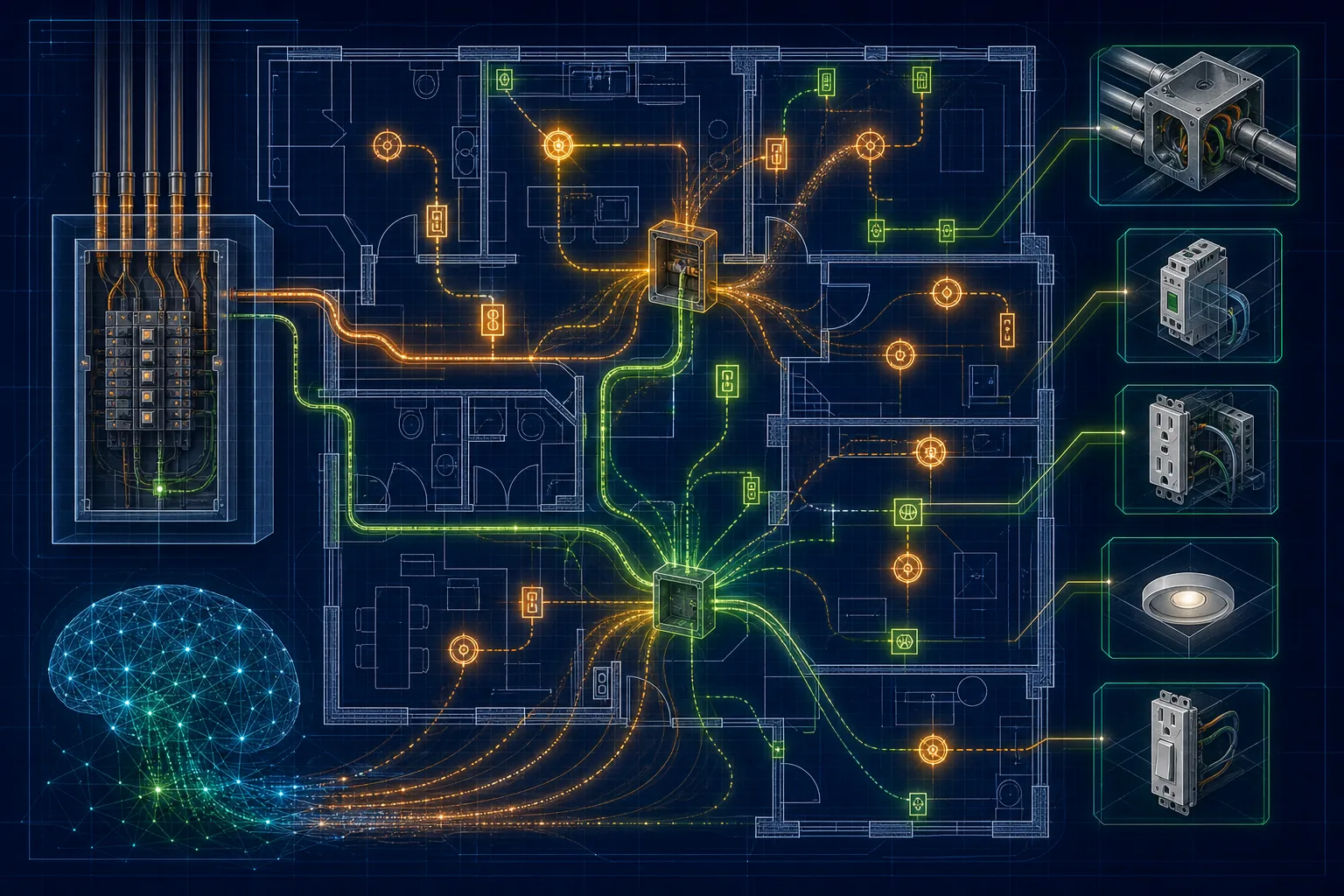
Aginera's circuit linker reads the panel schedule from your drawings, identifies every branch circuit, and matches extracted devices to their circuits based on circuit numbers, panel references, and load characteristics. Then it does something no other takeoff tool does: it estimates the conduit run for each circuit as a whole, not per device.
Here's what happens behind the scenes:
-
Panel schedule parsing — The AI reads your panel schedule and identifies breaker assignments, circuit numbers, load descriptions, and voltage ratings.
-
Device-to-circuit matching — Extracted receptacles, light fixtures, switches, and other devices are linked to their branch circuits using circuit numbers and panel references from the drawings.
-
Conduit sizing — Using NEC Chapter 9 Table 1 fill requirements (40% for three or more conductors), the system selects the right conduit size. A 3/4" EMT minimum is applied for commercial work, with automatic upsizing for long runs or high conductor counts.
-
Junction box placement — When cumulative bends on a conduit run exceed 360 degrees (per NEC 314.28), the system automatically adds junction boxes and resets the bend count.
-
Wire quantity calculation — Conductor counts and gauges are derived from the circuit load, and wire quantities are calculated based on the conduit run length — not inflated by multiplying length by conductor count.
The result: you get a complete list of conduit items, wire items, and junction boxes for every circuit, with proper sizing, lengths, and NEC references — in seconds instead of hours.

What You Get
For a typical 39-page electrical drawing set, Aginera produces:
- 60+ circuit-linked conduit runs with proper EMT/rigid sizing
- Wire quantities per circuit (not per device) with correct conductor counts
- Automatic junction boxes placed per NEC bend limits
- Panel-to-device traceability — every item links back to its panel and circuit number
An estimator working manually might spend 6–8 hours building this same takeoff. Aginera does it in under 60 seconds.
Feature 2: NEC/NFPA Code Compliance Audit
The Problem
Code compliance is typically checked after the estimate is built — or worse, during construction. Finding violations at that stage means rework, change orders, and delays. Estimators with deep NEC knowledge catch issues early, but that expertise takes years to develop and is hard to scale.
How Aginera Does It
After extraction is complete, Aginera runs a 17-category NEC/NFPA 70 compliance audit against every item in your takeoff. It doesn't just check that items exist — it validates that the design, as extracted, meets code requirements.
The audit engine covers:
| Category | What It Checks |
|---|---|
| Load Calculations | NEC Article 220 — are branch circuits properly loaded? |
| Conductor Sizing | NEC 310 — are wire gauges adequate for the load and distance? |
| Overcurrent Protection | NEC 240 — do breaker ratings match conductor ampacity? |
| GFCI Protection | NEC 210.8 — are kitchens, bathrooms, and outdoor receptacles GFCI-protected? |
| AFCI Protection | NEC 210.12 — are bedrooms, living areas, and other habitable rooms AFCI-protected? |
| Receptacle Spacing | NEC 210.52 — are receptacles placed per the 6/12-foot rule? |
| Working Clearances | NEC 110.26 — is there adequate space in front of panels and equipment? |
| Raceway Fill | NEC Chapter 9 — are conduits overfilled? |
| Box Fill | NEC 314.16 — are junction boxes and device boxes properly sized? |
| Emergency Systems | NEC 700/701 — are emergency and legally required standby systems compliant? |
| Panelboard Rating | NEC 408 — are panels properly rated for the connected load? |
Each check produces a clear result: pass, warning, or violation, with the specific NEC article reference and a plain-language recommendation.

Beyond Electrical: Multi-Discipline Compliance
The audit isn't limited to electrical. For full MEP drawing sets, Aginera also checks:
- NFPA 13 — Sprinkler system coverage and spacing
- NFPA 72 — Fire alarm device placement and spacing
- IMC/UPC — Plumbing fixture counts and pipe sizing
- IMC — Mechanical clearances and equipment access
The system even identifies your jurisdiction from the project address — so a project in California gets checked against NEC with local amendments, while a project in Dubai gets checked against DEWA/ADDC standards.
Why It Matters for Your Bid
Code issues found during estimation are cheap to address. Code issues found during construction are expensive. By surfacing violations before you submit your bid, you can:
- Flag design issues to the engineer during bid clarification
- Include allowances for likely corrections
- Demonstrate expertise to the GC by noting compliance items in your proposal
- Avoid costly field rework and inspection failures
Feature 3: The AI Quality Agent — Self-Improving Extraction
This is the game changer.
The Problem with Traditional AI Extraction
Every AI extraction system makes mistakes. A vision model might misread a symbol. A text parser might grab a room label instead of a device. Wire quantities might be inflated because the system counted conductor length instead of conduit length.
The traditional solution is manual review: an estimator goes through every line item, checks quantities, flags errors, and fixes them by hand. That's time-consuming, and it means every extraction starts from scratch — the system never gets better.
How Aginera's Quality Agent Works
After every extraction, Aginera automatically deploys a Quality Agent in the background. You see a simple notification: "Automatic Quality Check Initiated — if there are items missing, extraction will be readjusted." Then you keep working while the agent does its job.
Here's what happens behind the scenes:

Step 1: Assessment
The Quality Agent reviews every extracted item against the drawing context. It checks for:
- Completeness — Are there items that should be in this type of drawing but aren't? A 39-page electrical set should have panels, conduit, wire, receptacles, lighting, fire alarm devices, and junction boxes.
- Accuracy — Do quantities make sense for the project scope? Is 768 LF of wire for a single branch circuit reasonable?
- Noise — Did the extraction pick up architectural room labels, revision notes, or other non-material text as line items?
- Duplicates — Are the same items counted multiple times across overlapping sheets?
- Units — Is a conduit run measured in linear feet or was it accidentally converted to linear meters?
Step 2: Fix
This is where it gets interesting. The Quality Agent doesn't just flag problems — it fixes them directly.
-
Wire quantity corrections — If a wire item has a quantity that's exactly 3x or 4x the conduit run length (because the system multiplied by conductor count), the agent divides it back to the correct conduit length. In our testing, this corrected 20 items per project on average.
-
Noise removal — Room labels like "NIGHTCLUB 1 BELOW" or "COCKTAIL LOBBY & AMENITIES" that were incorrectly extracted as electrical items get flagged and removed. In one test project, the agent cleaned out 10 noise items in a single pass.
-
Duplicate merging — When the same luminaire type appears on multiple sheets and gets counted separately, the agent merges them into a single consolidated quantity.
-
Quantity adjustments — If a device count doesn't match the visible symbols on the drawing, the agent corrects it.
Step 3: Learn
This is what makes the Quality Agent truly different from a one-time check. When the agent identifies a pattern of errors — say, wire quantities are consistently inflated by conductor count — it doesn't just fix the current project. It creates a new extraction rule that prevents the same mistake on future projects.
These rules are stored as dynamic extraction rules that get applied to every subsequent extraction. Over time, the system gets smarter. Your 100th project extracts more accurately than your first, without any manual intervention.

Real Results from Real Projects
We tested the Quality Agent across three very different project types:
| Project | Type | Items Extracted | QA Fixes Applied | What It Did |
|---|---|---|---|---|
| Hospital Nuclear Medicine Wing | 39-page medical facility | 299 items | 20 fixes | Corrected wire quantities on 20 circuits (divided inflated conductor counts back to actual run lengths) |
| VA Medical Center | 26-page government facility | 206 items | 20 fixes | Fixed 20 wire quantity errors, flagged unit mismatches (SQM vs SF) |
| Nightclub & Hospitality Venue | 13-page commercial entertainment | 33 items (cleaned) | 17 fixes | Removed 10 architectural room labels as noise, merged 3 duplicate luminaire types, corrected 4 quantities |
Every project scored 75/100 on the first pass — and the agent applied targeted fixes to bring each extraction to production quality. The entire process takes 30–60 seconds in the background. The estimator doesn't wait.
Why This Is a Game Changer
Traditional takeoff tools are static. They extract what they extract, and you fix the rest manually.
Aginera's Quality Agent creates a feedback loop:
Extract → Assess → Fix → Learn → Extract Better Next Time
Every project your team runs through the system makes the next project more accurate. Extraction rules accumulate. Common mistakes get caught automatically. Domain-specific patterns — like the wire quantity multiplier issue — get solved once and never appear again.
For an electrical contractor running 50 bids a month, this means:
- Less manual review time — The agent catches the errors you'd spend 30–60 minutes finding manually
- More accurate bids — Quantity errors that inflate or deflate your bid price get corrected automatically
- Consistent quality — Whether your senior estimator or a junior team member runs the takeoff, the Quality Agent applies the same standard
- Continuous improvement — The system genuinely gets better with use, adapting to your project types and drawing styles
How AI Is Transforming the Estimator's Daily Routine
If you're an electrical estimator reading this, you might wonder: is AI going to replace my job?
No. It's going to change it — for the better.
Here's what a typical bid day looks like without AI:
- Receive drawings (150 pages) — 5 minutes
- Sort and classify sheets — 30 minutes
- Count devices across 40+ electrical sheets — 3–4 hours
- Trace conduit runs and size raceways — 4–6 hours
- Cross-reference panel schedules — 1–2 hours
- Build assemblies and look up pricing — 2–3 hours
- Review for errors — 1–2 hours
- Total: 12–18 hours per bid
Here's what it looks like with Aginera:
- Upload drawings — 2 minutes
- AI extracts devices, traces conduit, links circuits — 3–5 minutes
- Quality Agent reviews and corrects — 1 minute (background)
- NEC compliance audit runs — 30 seconds
- Review AI results and adjust — 30–60 minutes
- Generate priced estimate — 5 minutes
- Total: under 2 hours per bid
That's not replacing the estimator. It's giving the estimator superpowers. Instead of spending a full day on mechanical counting and tracing, you spend your time on judgment calls: reviewing the AI's work, adjusting for site conditions, and focusing on the items that require human expertise.
The estimator's role shifts from data entry to quality control and strategy. That's a better job, and it lets you bid on more projects with the same team.

The Technical Edge: Why Specialized AI Matters
You might wonder — can't ChatGPT or a general-purpose AI do this?
In short: no.
General-purpose AI models know a little about everything. They can explain what NEC 210.8 says about GFCI protection. But they can't read a panel schedule from Sheet E-2.1, link Circuit 7 to the four receptacles on the floor plan, determine that the run needs 3/4" EMT with three #12 THWN-2 conductors, and calculate 52 LF of conduit with one junction box at the 270-degree bend point.
That requires a vertical AI — one trained specifically on construction documents, wired into NEC code tables, and built to understand the relationship between a panel schedule and a floor plan. Aginera's extraction pipeline combines:
- Vision models that read drawing symbols and annotations the way an estimator does
- Text extraction that parses panel schedules, equipment tags, and title blocks
- Domain logic that applies NEC sizing rules, conduit fill calculations, and assembly standards
- Quality assurance that catches and corrects the kinds of errors that only an experienced estimator would notice
This isn't a generic document scanner with a construction skin. It's purpose-built engineering intelligence.
Getting Started
Whether you're a one-person estimating shop or a 50-person preconstruction team, Aginera's new features work the same way:
- Upload your drawings — PDF or CAD, any size, any discipline
- Get a full takeoff in minutes — devices, conduit, wire, junction boxes, all circuit-linked
- Review the NEC audit — catch compliance issues before they become field problems
- Let the Quality Agent work — it checks, corrects, and learns in the background
- Generate your estimate — priced, sectioned, and ready for your proposal
Every extraction makes the next one better. Every project adds to the system's knowledge. The more you use it, the more accurate it gets.
Ready to See It in Action?
Stop spending full days on manual takeoffs. Stop wondering if you missed something on page 37. Stop inflating your bid because you're not sure about conduit quantities.
Start your free trial at aginera.ai and run your next electrical takeoff in under 5 minutes. Upload a drawing set and see the conduit runs, wire quantities, NEC audit, and Quality Agent corrections for yourself.
Your competitors are already bidding faster. It's time to bid smarter.
Aginera.ai is an AI-powered construction takeoff and estimating platform purpose-built for electrical contractors, MEP estimators, and engineering firms. From device counting to bid-ready estimates, Aginera's AI agents handle the heavy lifting so your team can focus on winning work.