How AI Electrical Takeoff Is Changing the Game for Low-Voltage and Communications Contractors
If you run or estimate for a low-voltage, BDA/DAS, fire alarm, or CCTV contracting firm, you know the drill. A general contractor sends over a 150-page drawing set. Your estimator spends two to three days — sometimes a full week — manually counting devices, tracing conduit runs, cross-referencing panel schedules, and building a price. By the time the bid is ready, the deadline is tomorrow and you've already lost the margin to rushed math.
This is the problem Aginera's AI electrical takeoff software was built to solve.
The Real Cost of Manual Electrical Takeoff
Manual takeoff isn't just slow — it's structurally expensive. For a typical commercial electrical project:
| Activity | Manual Time | % of Estimating Effort |
|---|---|---|
| Device counting (fixtures, receptacles, panels) | 4–8 hours | 25% |
| Conduit and wire quantification | 6–12 hours | 35% |
| Panel schedule cross-referencing | 2–4 hours | 15% |
| Assembly and labor buildup | 3–6 hours | 20% |
| Sanity checking and QA | 1–2 hours | 5% |
For a 100-page drawing set, that's 16–32 hours of estimator time per bid. If you're bidding 8–10 projects a month, that's a full-time person doing nothing but counting symbols on PDFs.
The hidden cost is the bids you don't submit. When takeoff takes three days, you're forced to cherry-pick which projects to pursue. Every skipped bid is lost revenue.
What Automated Electrical Extraction Actually Does
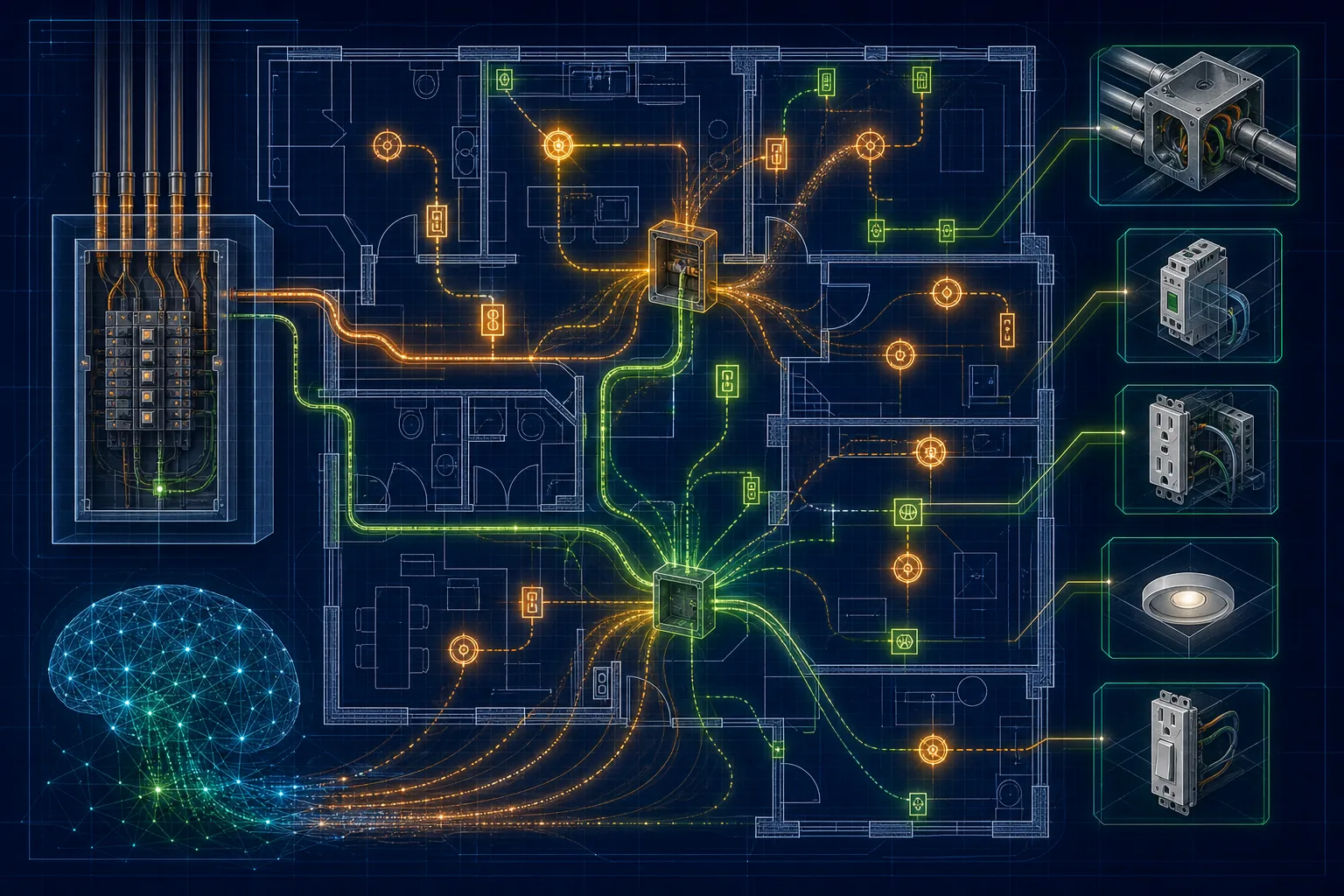
Aginera's extraction pipeline processes construction drawing PDFs the same way an experienced estimator reads them — but in minutes instead of days. Here's what happens under the hood:
Stage 1: Sheet Classification
The system reads every page in the drawing set and classifies it by discipline and purpose. Electrical one-line diagrams, power plans, lighting plans, panel schedules, and riser diagrams are each routed to specialized extraction logic. Title sheets, architectural plans, and mechanical drawings are recognized and excluded.
This matters because a 150-page set might contain only 30–40 electrical sheets. An estimator who manually flips through every page wastes time on irrelevant drawings. The AI skips them instantly.
Stage 2: Symbol and Device Extraction
Computer vision identifies every electrical symbol on the drawings — receptacles, switches, light fixtures, junction boxes, fire alarm devices, pull stations, CCTV cameras, BDA antennas, and more. Each symbol is classified by type and counted.
For a recent 150-page commercial project, this stage identified 327 unique components across categories:
- Power: Duplex receptacles, GFCI outlets, dedicated circuits, disconnect switches
- Lighting: LED fixtures, emergency lights, exit signs, occupancy sensors
- Fire Alarm: Pull stations, smoke detectors, horn/strobes, FACP
- Low Voltage: CCTV cameras, BDA/DAS antennas, access control readers, data outlets
- Distribution: Panelboards, transformers, feeders, branch circuits
Stage 3: Panel Schedule Parsing
The pipeline reads panel schedule tables directly from the drawings — breaker ratings, circuit designations, connected loads, and voltage levels. This feeds the conduit and wire inference engine.
If a panel schedule shows a 20A/120V branch circuit serving six duplex receptacles, the system knows that circuit needs 12/2 THHN in 3/4" EMT. If it shows a 100A/480V feeder to a mechanical panel, it calculates the appropriate conductor size and conduit.
Stage 4: Conduit and Wire Inference
This is where most manual estimators lose the most time — and where the most estimation errors happen. The system applies NFPA 70 and NEC-aligned rules to infer:
- Conductor sizing from circuit ampacity and voltage drop
- Conduit sizing from conductor fill calculations
- Run lengths from floor plan scale and routing assumptions
- Raceway type (EMT, rigid, flex) from specification cross-referencing
For a typical commercial project, conduit and wire represent 40–60% of total material cost. Getting this wrong by even 10% can destroy your margin.
Stage 5: Assembly Expansion
Every device gets expanded into a full assembly — the box, plate, connectors, conduit home-run, wire, and labor. A single duplex receptacle becomes:
| Component | Quantity | Unit |
|---|---|---|
| Duplex receptacle | 1 | EA |
| Single-gang box | 1 | EA |
| Single-gang plate | 1 | EA |
| 3/4" EMT conduit | 15 | LF |
| 12 AWG THHN wire | 45 | LF |
| EMT connectors | 2 | EA |
| Installation labor | 0.45 | HR |
This assembly-level expansion is what separates a "symbol count" from a "bid-ready estimate." Without it, you're pricing devices without the infrastructure that connects them.
Why This Matters for BDA/DAS and Communications Contractors
BDA (Bi-Directional Amplifier) and DAS (Distributed Antenna System) contractors face a unique version of this problem. Your drawings show antenna locations, headend equipment, coaxial runs, and signal coverage areas. Estimating a BDA system means quantifying:
- Donor and coverage antennas per floor
- Coaxial cable runs (typically 1/2" or 7/8" plenum-rated)
- Splitters, couplers, and tappers at each junction
- Headend equipment (BDA, fiber, power supply)
- Conduit for cable routing
- Fire-stopping at penetrations
- Labor for ceiling access, mounting, and testing
A 20-story building might have 200+ antenna locations, each requiring a cable run back to a riser or IDF. Tracing those runs manually on a floor plan is exactly the kind of repetitive, error-prone work that AI extraction handles well.
The same applies to CCTV contractors counting camera locations and calculating cable pulls, or fire alarm contractors mapping device loops back to the FACP.
What the Output Looks Like
After extraction, you get a structured takeoff that's ready for pricing — not a raw list of symbols. Each item includes:
- Description: Normalized and cleaned (no OCR garbage)
- Category: Power, Lighting, Fire Alarm, Low Voltage, Distribution, Raceway
- Quantity and Unit: With appropriate UOM (EA, LF, SF)
- Confidence Score: High, medium, or review-needed
- Sheet Reference: Which drawing page the item was found on
- Status: Auto-approved, needs review, or low confidence
Items flagged for review are typically edge cases — custom symbols, non-standard abbreviations, or overlapping annotations. The system doesn't guess; it flags uncertainty explicitly so your estimator can verify the 5% that needs human judgment instead of redoing the 95% that doesn't.
Real Numbers: Before and After
On a recent 150-page commercial electrical project (a building renovation with full E-series drawings), Aginera's pipeline produced:
- 327 components extracted and classified
- Full conduit/wire inference for all power and lighting circuits
- 96 panel schedule entries parsed from 12 panels
- Estimate total: ~$500K (aligned with manual estimate range)
- Time: 4 minutes (vs. 3 days manual)
The estimate isn't perfect out of the box — no automated system is. But it's 90–95% complete, and the remaining 5–10% is review work, not from-scratch counting.
Getting Started
If you're an electrical, low-voltage, BDA/DAS, fire alarm, or CCTV contractor spending more than a day on takeoffs, the economics are straightforward: every hour your estimator spends counting symbols is an hour they're not refining pricing, negotiating with suppliers, or bidding the next project.
Aginera's extraction pipeline handles the counting. Your estimators handle the judgment.