AI Construction Estimating in India: How MEP Contractors Are Automating Takeoffs and BOQs in 2026
India's construction industry is on a trajectory unlike any other market in the world. With a projected market size of $1.3 trillion by 2030, driven by the Smart Cities Mission, rapid urbanization, massive metro infrastructure expansion, and the single largest pipeline of commercial and industrial development in the country's history, Indian MEP contractors are busier than they have ever been.
Yet the way most Indian contractors prepare estimates has barely changed in two decades. The BOQ is still assembled manually. Quantities are still scaled off printed drawings or counted from PDFs one fixture at a time. Rates are still looked up from CPWD schedules or vendor quotations and entered into Excel. An estimating team of three people might spend five to seven days preparing the schedule of quantities for a single mid-rise commercial building — and then repeat the entire process when the consultant issues a revision.
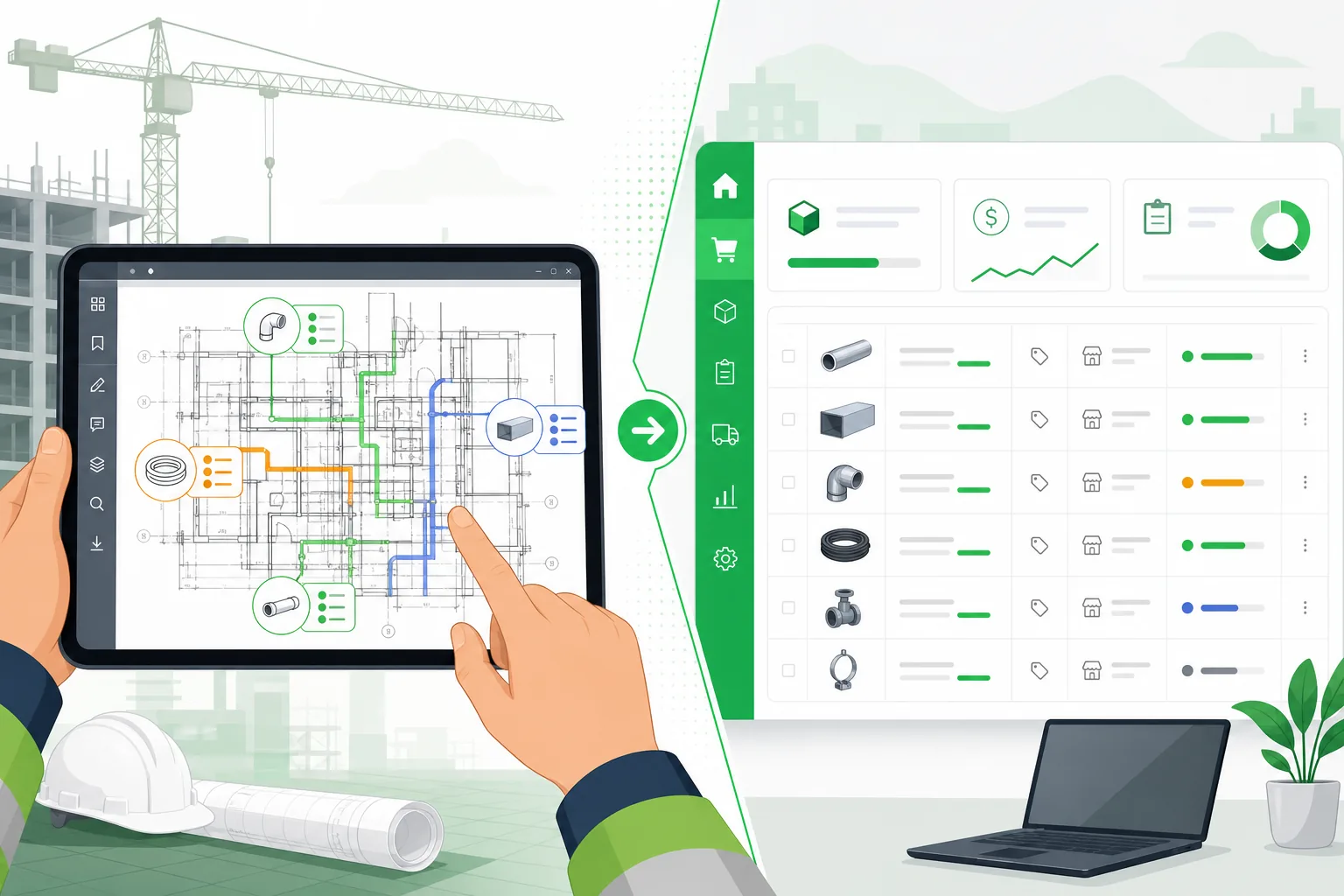
AI construction estimating software is changing this. Platforms purpose-built for MEP takeoff and BOQ preparation can now read construction drawings, identify every component, extract quantities, and produce a structured bill of quantities in minutes instead of days. For Indian contractors competing on tight margins with aggressive bid timelines, this is not a luxury — it is a competitive advantage that directly impacts the number of tenders you can respond to and the accuracy of the estimates you submit.
This guide explains how AI-powered estimating works, why it matters specifically for the Indian construction market, and how MEP contractors across India are using it to automate the most time-consuming part of their workflow.
The Indian Construction Estimating Landscape
Scale and Opportunity
India is the third-largest construction market globally, and the numbers are staggering:
- $1.3 trillion projected construction market by 2030 (India Brand Equity Foundation)
- 100 Smart City projects under the government's Smart Cities Mission, each requiring extensive MEP infrastructure
- Over 25 metro rail systems under construction or in planning across Tier 1 and Tier 2 cities
- 520+ million square feet of commercial real estate under development in the top seven cities alone
- Green building mandates accelerating, with IGBC and GRIHA certifications increasingly required for large commercial projects
For MEP contractors, this means more tenders, larger drawing sets, tighter deadlines, and clients who expect detailed BOQs with IS code-compliant specifications. The volume of work is not the constraint. The constraint is the capacity to estimate it all.
How Indian Contractors Estimate Today
The typical estimating workflow at an Indian MEP contracting firm follows a pattern that will be familiar to anyone in the industry:
- Receive tender documents — drawings (often 100–400 pages), specifications (IS code references, project-specific requirements), and the client's BOQ format (if provided)
- Print or view drawings — many firms still print A1-size sheets for manual scaling; others work from PDFs on screen
- Manual quantity takeoff — estimators count fixtures, measure duct and conduit runs, read panel schedules, and tally piping lengths sheet by sheet
- BOQ preparation — quantities are compiled into the Bill of Quantities format, typically in Excel, following the client's prescribed structure or the firm's standard abstract of cost format
- Rate application — unit rates are applied from CPWD/DSOR rate analysis, recent vendor quotations, or the firm's internal rate database
- Review and submission — a senior estimator or project manager reviews the BOQ, makes adjustments, and the bid is submitted
This process works. It has worked for decades. But it does not scale.
| Metric | Current Reality |
|---|---|
| Time per BOQ (mid-rise commercial) | 5–7 days |
| Estimators needed per BOQ | 2–3 |
| Tenders responded to per month | 4–6 |
| Tenders available but skipped | 10–15+ |
| Common errors | Missed items, wrong quantities, outdated rates |
| Revision handling | Partial or full re-takeoff |
When a firm can only bid four to six projects per month because the estimating team is at capacity, every tender skipped is revenue left on the table. At average project values of INR 5–20 crore (USD 600K–2.4M) for mid-size MEP contracts, even one additional successful bid per month represents significant revenue.
Why Manual BOQ Preparation is the Bottleneck
The BOQ — the Bill of Quantities — is the backbone of Indian construction estimating. Unlike markets where a simple material takeoff suffices for initial pricing, Indian clients, consultants, and government bodies typically require a structured BOQ with:
- Item descriptions with IS code references (IS 732 for electrical wiring, IS 1239 for GI pipes, IS 3589 for steel pipes, and so on)
- Unit of measurement per item (Nos., RM, Sqm, Set, Lot)
- Quantities derived from the drawing set
- Unit rates with detailed rate analysis (material + labour + overhead + profit)
- Abstract of cost summarizing by trade and system
Preparing this manually from a 200-page MEP drawing set means an estimator is spending 60–70% of their time on the takeoff — counting, measuring, and compiling — and only 30–40% on the value-added work of rate analysis, vendor negotiation, and bid strategy.
AI takeoff software automates the 60–70%.
How AI Construction Estimating Works for Indian Projects
AI-powered construction estimating uses computer vision and domain-specific engineering logic to read construction drawings and produce structured quantity outputs. Here is what happens when you upload an Indian MEP drawing set to an AI takeoff platform like Aginera.
Step 1: Sheet Classification
A typical Indian MEP drawing set for a commercial project includes:
- Electrical power layout plans (floor-wise)
- Electrical lighting layout plans
- Electrical single line diagrams and panel schedules
- HVAC duct layout plans
- HVAC piping layout plans
- HVAC equipment schedules
- Plumbing layout plans and riser diagrams
- Fire fighting sprinkler and hydrant layout plans
- Fire alarm layout plans
- Low voltage / ELV system layouts (CCTV, access control, PA, BMS)
The AI classifies each sheet by discipline and type, routing electrical sheets to the electrical extraction model, mechanical sheets to the HVAC model, and so on. This classification step is critical because a symbol that means one thing on an electrical drawing means something entirely different on a fire alarm drawing.
Step 2: Component Recognition and Counting
The computer vision model identifies every symbol, device, fixture, and equipment item on each drawing. For an electrical floor plan of a typical Indian office building, this includes:
- Power: 5A and 15A socket outlets, 20A power outlets, industrial sockets, MCBs, DBs, bus ducts
- Lighting: LED downlights, panel lights, strip lights, emergency lights, exit signs, outdoor lights
- Fire alarm: Smoke detectors (photoelectric and ionization), MCP (manual call points), hooters, response indicators, FACP
- Low voltage: RJ45 data outlets, CCTV cameras (dome, bullet, PTZ), access control readers, speakers, BMS points
The model is trained on the drawing conventions commonly used by Indian MEP consultants and follows IS/BIS symbol standards alongside international conventions.
Step 3: Linear Measurement and Area Calculation
Beyond counting individual devices, the AI measures:
- Conduit runs — GI conduit, PVC conduit, and cable tray lengths from the floor plan
- Ductwork — supply, return, and exhaust duct lengths with cross-sectional dimensions
- Piping — chilled water, hot water, domestic plumbing, fire fighting, and drainage pipe lengths
- Cable lengths — inferred from panel schedule circuit assignments and floor plan routing
Step 4: Schedule and Table Parsing
Indian MEP drawings contain critical data in tabular schedules:
- Panel schedules (DB schedules) — circuit-wise breaker ratings, connected loads, wire sizes
- Fixture schedules — lamp types, wattages, mounting heights, quantities per type
- Equipment schedules — AHU capacities, pump specifications, DG set ratings, transformer specifications
- Fire fighting schedules — sprinkler types, coverage areas, system zones
The AI parses these tables automatically, cross-referencing schedule data with the quantities extracted from floor plans to produce a complete and internally consistent takeoff.
Step 5: BOQ Generation
The extracted quantities are organized into a structured Bill of Quantities. For Indian projects, this means:
- Item-wise listing with descriptions following IS code terminology
- Grouped by system — electrical power, lighting, fire alarm, HVAC, plumbing, fire fighting, ELV
- Standard units — Nos., RM (running metres), Sqm, Set, Lot, as per Indian convention
- Ready for rate application — the BOQ structure is ready to receive your CPWD rates, DSOR rates, or custom unit rates
What AI Estimating Means for Indian MEP Trades
Electrical Estimating
Electrical work on Indian commercial projects is uniquely complex. A single 20-storey commercial tower might have:
- 3,000+ socket outlets across floor plans
- 2,000+ lighting fixtures across reflected ceiling plans
- 50+ distribution boards with panel schedules
- 500+ fire alarm devices
- 1,000+ low voltage / ELV points
- Kilometres of conduit, cable tray, and wiring
Manual takeoff for this scope takes a team of two to three estimators a full week. AI processes it in under 10 minutes and produces the complete schedule of quantities.
The AI handles Indian-specific electrical conventions:
- IS 732 compliance for wiring specifications
- FRLS (Fire Retardant Low Smoke) cable specifications standard in Indian commercial projects
- MCB/MCCB/RCCB protection devices per IS/IEC standards
- DB (Distribution Board) nomenclature and scheduling formats used by Indian consultants
- Bus duct and rising main calculations for high-rise buildings
Learn more about AI electrical estimating capabilities
Mechanical / HVAC Estimating
India's HVAC market is growing at over 10% annually, driven by commercial real estate, data centres, hospitals, and the increasing adoption of centralized air conditioning in Tier 2 and Tier 3 cities. AI takeoff handles:
- VRF/VRV systems — the dominant system type in Indian commercial fit-outs
- Chilled water systems — AHUs, FCUs, chillers, cooling towers, and associated piping for large commercial and institutional projects
- Ductwork — GI ducts with insulation specifications per IS standards
- Ventilation — exhaust fans, fresh air handling, basement ventilation (critical for Indian building codes)
- BMS integration points — increasingly required in smart building projects
Plumbing and Fire Fighting Estimating
Indian plumbing and fire fighting systems follow IS and NBC (National Building Code) standards with specific requirements:
- Fire fighting per NBC Part 4 and IS 15105 — sprinkler coverage, hydrant systems, wet riser, and dry riser requirements
- Plumbing per IS 2065 for water supply and IS 1742 for drainage — including overhead tank, underground sump, and booster pump systems standard in Indian high-rises
- STP (Sewage Treatment Plant) and WTP (Water Treatment Plant) sizing — required for most large Indian commercial projects
- Rainwater harvesting systems — mandatory in many Indian states and smart city projects
Explore Aginera's full MEP takeoff capabilities
Moving from Manual BOQ to Automated Takeoff
Transitioning from a manual BOQ workflow to an AI-powered one does not mean abandoning your existing process overnight. The most successful Indian contractors adopt AI takeoff in phases.
Phase 1: Parallel Validation (Week 1–2)
Run your next project through both your manual process and the AI platform simultaneously. Compare the outputs:
- Do the component counts match?
- Are the linear measurements within acceptable tolerance (typically 5–10%)?
- Does the BOQ structure align with how your team organizes estimates?
- Are the IS code references and item descriptions appropriate?
This parallel run builds confidence in the AI output and helps your team understand where the AI excels and where human judgment adds value.
Phase 2: AI-First with Senior Review (Week 3–6)
Start using the AI takeoff as your primary output. A senior estimator reviews the flagged items and makes adjustments. Junior estimators shift from counting to reviewing and rate application.
In this phase, most teams see:
- 60–70% reduction in takeoff time
- Fewer missed items because the AI scans every sheet systematically
- More consistent BOQs because the AI applies the same logic to every project
Phase 3: Full Integration (Month 2+)
The AI takeoff becomes your standard workflow. Your team's time allocation shifts:
| Activity | Before AI | After AI |
|---|---|---|
| Quantity takeoff (counting, measuring) | 60–70% | 10–15% |
| BOQ review and adjustment | 10% | 20% |
| Rate analysis and vendor negotiation | 15% | 35% |
| Bid strategy and proposal preparation | 10% | 30% |
The shift is significant. Your estimators spend less time on low-value counting and more time on high-value pricing strategy and bid optimization — the work that actually wins projects.
ROI for Indian MEP Contractors
The return on investment for AI estimating software in the Indian market is compelling, especially given the volume of tender opportunities available.
Direct Cost Savings
| Metric | Manual | AI-Powered | Savings |
|---|---|---|---|
| Takeoff hours per BOQ | 40–50 hours | 6–8 hours | 34–42 hours |
| BOQs per month | 5 | 5 | — |
| Monthly takeoff hours (team) | 200–250 hours | 30–40 hours | 170–210 hours |
| Estimator cost per hour (India) | INR 500–800 (~USD 6–10) | INR 500–800 | — |
| Monthly takeoff labor cost | INR 1.0–2.0 lakh | INR 15,000–32,000 | INR 70,000–1.7 lakh |
Revenue Impact from Increased Bid Volume
The bigger prize is not cost savings — it is revenue. When your estimating team can produce BOQs three to four times faster, you can respond to three to four times more tenders.
| Scenario | Manual | AI-Powered |
|---|---|---|
| Tenders responded per month | 5 | 15 |
| Win rate | 20% | 20% |
| Projects won per month | 1 | 3 |
| Average project value | INR 10 crore (~USD 1.2M) | INR 10 crore |
| Monthly revenue pipeline | INR 10 crore | INR 30 crore |
Even if you assume a conservative 15% net margin on MEP contracts, the incremental revenue from two additional project wins per month translates to INR 3 crore in additional annual profit. Against a software investment of INR 5–10 lakh per year, the payback period is measured in weeks, not months.
Accuracy and Risk Reduction
Manual BOQ errors carry direct financial consequences in the Indian contracting environment:
- Underestimation — you win the project but lose money because quantities were understated. On lump-sum contracts common in Indian private sector projects, this comes directly out of your margin.
- Overestimation — your bid is uncompetitive, and you lose the tender to a competitor who estimated more accurately. In the Indian market where L1 (lowest bidder) selection is the norm for government and many institutional projects, even a 3–5% overestimate can cost you the job.
- Missing items — items not included in the BOQ are items you absorb during execution. On a large MEP project, missed items can easily add up to INR 10–50 lakh in unrecovered costs.
AI takeoff reduces these risks by systematically scanning every sheet, parsing every schedule, and flagging items where confidence is low rather than silently skipping them.
Addressing Common Concerns from Indian Contractors
"Will it work with Indian drawing standards?"
Yes. AI takeoff platforms process drawings regardless of the symbol conventions used. Indian MEP drawings follow a mix of IS/BIS standards, IEC standards, and consultant-specific symbol libraries. The AI models are trained on diverse drawing sets including those from major Indian MEP consultants. Whether your drawings use the exact IS 962 electrical symbol set or a consultant's custom legend, the platform identifies components based on visual pattern recognition across thousands of drawing variations.
"Does it handle IS code specifications?"
The platform extracts what is on the drawings and in the schedules. Item descriptions in the generated BOQ reference standard terminology consistent with IS code practice — FRLS cables, GI conduit per IS 9537, copper wiring per IS 8130, GI pipes per IS 1239, and similar. For rate analysis, you apply your own CPWD/DSOR rates or custom rates, ensuring the final BOQ meets whatever specification standard the project requires.
"Can it generate BOQs in the format Indian clients expect?"
The BOQ output is structured and exportable to Excel. You can map the output to any format your client requires — whether it is a standard CPWD BOQ format, a consultant-prescribed abstract of cost, or your firm's internal estimate template. The key value is that the quantities and item structure are already extracted and organized; formatting for a specific client template is a final-step adjustment.
"What about drawings with regional language annotations?"
Many Indian construction drawings include annotations in Hindi, Tamil, Telugu, Marathi, or other regional languages alongside English. The AI focuses primarily on symbol recognition and geometric analysis rather than text-only parsing, so regional language annotations do not block the extraction process. Technical data in schedules and legends — which is almost always in English on Indian engineering drawings — is parsed normally.
"Is it suitable for government projects with CPWD rates?"
AI takeoff software handles the quantity extraction side of the estimate. For government projects priced using CPWD Schedule of Rates (DSOR), you extract quantities using the AI and then apply CPWD rates in the pricing step. The platform does not prescribe rates — it gives you accurate quantities, and you apply whatever rate framework the project requires. This works equally well for CPWD rates, state PWD rates, or custom rate analysis.
"Do we need to change our existing workflow completely?"
No. The AI integrates into your existing process by replacing the manual takeoff step. Your review process, rate application methodology, senior estimator sign-off, and bid submission workflow remain the same. The difference is that instead of spending five days preparing the BOQ, you spend five minutes on the AI takeoff and the rest of the time on review and pricing.
Indian Project Types Where AI Estimating Has the Highest Impact
Commercial High-Rises and IT Parks
Large commercial buildings with 15–30 floors and repetitive floor plates are ideal for AI takeoff. The repetitive nature means the AI processes a typical floor and scales quantities across the building efficiently. For IT parks with multiple buildings, a single drawing set upload covers the full campus.
Hospitals and Healthcare Facilities
Hospital MEP systems are among the most complex — medical gas, nurse call systems, specialized HVAC for OTs and ICUs, extensive fire alarm coverage, and stringent IS/NBC code requirements. A 300-bed hospital might have a 400-page MEP drawing set. AI takeoff handles the volume and complexity while flagging specialized medical systems for expert review.
Metro and Transit Infrastructure
India's metro expansion is creating massive MEP tender volumes across 25+ cities. Station MEP — ventilation, fire fighting, electrical distribution, ELV systems — involves large drawing sets with strict compliance requirements. AI takeoff helps contractors respond to the high volume of metro tenders without proportionally scaling their estimating teams.
Smart City Infrastructure
Smart city projects combine conventional MEP with IoT infrastructure, intelligent lighting, building management systems, and integrated command and control centres. The technology layer adds complexity to the BOQ that AI handles by recognizing and categorizing both conventional and smart building components.
Industrial and Manufacturing Facilities
Pharmaceutical plants, data centres, food processing units, and manufacturing facilities have specialized MEP requirements — clean room HVAC, process piping, hazardous area electrical classifications, and redundant systems. AI takeoff extracts the base quantities while your engineers apply the specialized knowledge these projects demand.
The Technology Behind AI Construction Takeoff
Computer Vision Trained on Construction Drawings
The AI models used for construction takeoff are not general-purpose image recognition systems. They are trained specifically on the visual language of engineering drawings — symbols, line types, hatching patterns, dimension strings, and the spatial relationships between components.
A trained model distinguishes between a 5A socket outlet symbol and a 15A socket outlet symbol even when the visual difference is a single indicator mark. It recognizes that a circle on a reflected ceiling plan is a light fixture, not a sprinkler head, because of the sheet classification context.
Domain Engineering Rules
Raw symbol counting is only the beginning. The real value comes from engineering rules that expand counted components into complete assemblies:
For each socket outlet counted on an Indian electrical drawing:
- The outlet device (5A/15A/20A per specification)
- PVC or GI conduit from the outlet to the DB (sized per IS 9537)
- FRLS copper wiring (sized per IS 694 and IS 732 for the circuit type)
- Modular plate and box
- Installation labour
Without assembly expansion, a takeoff that counts 500 socket outlets captures maybe 15% of the actual installed cost. With assembly expansion, it captures 85–95%.
Confidence Scoring
Every extracted item receives a confidence score:
- High confidence (90%+): Standard symbols, clear drawing quality, common components. Automatically included in the BOQ.
- Medium confidence (70–90%): Non-standard symbol variants, partially obscured items, or unusual abbreviations. Flagged for quick review.
- Low confidence (below 70%): Ambiguous items, very poor drawing quality, or components the model has not seen before. Flagged for manual verification.
This means your estimator reviews 5–10% of the takeoff output rather than producing 100% from scratch. The human effort shifts from production to quality assurance.
Getting Started with AI Estimating for Your Indian Projects
If your estimating team is spending more days on quantity takeoff than on pricing strategy and bid preparation, AI takeoff software is the single highest-impact tool you can adopt. The math is straightforward: every day freed from counting is a day available for responding to an additional tender.
Here is how to start:
- Upload a recent project — pick a project where you already have a completed manual BOQ so you can compare the AI output against your known quantities
- Review the output — check component counts, linear measurements, and BOQ structure against your manual takeoff
- Run a second project — this time, use the AI takeoff as your starting point and build your priced BOQ from there
- Measure the time savings — most teams see a 70–80% reduction in takeoff hours from the second project onward
Start your free trial and run your first AI takeoff. Upload your drawings and see results in minutes — no demo call required.
For a deeper look at how AI takeoff technology works across all MEP trades, read our complete guide to AI-powered construction takeoffs.
Frequently Asked Questions
What is AI construction estimating software?
AI construction estimating software uses computer vision and machine learning to automatically read construction drawings (PDFs, DWG, DXF files), identify every component and material, extract quantities, and produce a structured Bill of Quantities (BOQ). It replaces the manual process of counting fixtures, measuring conduit and duct runs, and compiling the schedule of quantities — reducing the time from days to minutes.
How accurate is AI takeoff compared to manual BOQ preparation?
AI takeoff typically achieves 90–95% accuracy with full assembly expansion, compared to 85–90% for manual takeoffs. The AI eliminates arithmetic errors, missed sheets, and forgotten assembly items that are common in manual processes. Items where the AI has low confidence are flagged for human review rather than silently skipped or guessed.
Does AI takeoff software work with Indian drawing standards and IS codes?
Yes. The AI processes drawings based on visual symbol recognition, which works across IS/BIS symbol standards, IEC conventions, and consultant-specific symbol libraries used on Indian projects. BOQ item descriptions follow standard Indian terminology (FRLS cables, GI conduit per IS 9537, copper wiring per IS 694), and the output is compatible with CPWD, DSOR, and custom rate frameworks.
How much does AI estimating software cost, and what is the ROI for Indian contractors?
AI takeoff platforms typically range from INR 5,000–25,000 per month (USD 60–300) depending on the plan and project volume. For a contractor whose estimating team currently spends 200+ hours per month on manual takeoffs, the time savings alone recover the cost within the first week. The real ROI comes from increased bid volume — if you can respond to 10 additional tenders per month, even a modest win rate improvement generates crores in additional revenue annually.
Can I use AI takeoff for government projects priced using CPWD rates?
Absolutely. The AI handles quantity extraction — counting, measuring, and organizing items into a structured BOQ. You then apply CPWD Schedule of Rates, state PWD rates, or your own rate analysis in the pricing step. The platform does not prescribe rates; it provides accurate quantities in a format ready for any rate framework.
What file formats are supported?
The platform supports PDF drawings (the most common format for Indian project tenders), CAD files (DWG and DXF), and Revit models. PDF is sufficient for most Indian projects where drawings are distributed as part of the tender document set. CAD and Revit files provide additional layer and block data that can improve extraction accuracy.
How long does it take to process a large Indian commercial project?
A typical 150-page commercial building MEP drawing set processes in 3–5 minutes. A large hospital or campus project with 400+ pages might take 10–15 minutes. The subsequent human review step — checking flagged items and making adjustments — typically takes 30–60 minutes. Total time from upload to a review-ready BOQ is under one hour for most projects, compared to five to seven days for manual preparation.
Is training required for my estimating team to use AI takeoff software?
The learning curve is minimal. If your team can upload files and review a spreadsheet, they can use AI takeoff software. Most teams are productive within their first project. The workflow is intuitive: upload drawings, review the AI-generated BOQ, make adjustments where needed, apply rates, and export. No specialized AI or software training is required.