Beyond Symbol Counting: How AI Infers Complex Electrical Assemblies from 2D Plans
Walk into any electrical contractor's office during bid season and you will find the same scene: an estimator with a PDF on one monitor and a spreadsheet on the other, clicking through sheets, tallying symbols, and manually building assemblies line by line.
That workflow works. It has worked for decades. But it captures only the visible layer of what electrical estimating actually requires.
Counting 89 duplex receptacles is Layer 1. Knowing that those receptacles sit on a 20A branch circuit fed from panel LP-2A through 3/4 inch EMT with #12 THHN conductors, plus the boxes, connectors, straps, and labor to install them — that is the assembly layer. And it is where most AI electrical takeoff software either delivers real value or disappoints.
In 2026, the differentiator for the best AI electrical estimating software is not how many symbols it can count. It is how well it infers the assemblies, circuits, and code-aware scope that turn a device list into a bid.
This article explains how that inference works — and what estimators should expect from the technology.
The Five Layers of Electrical Scope
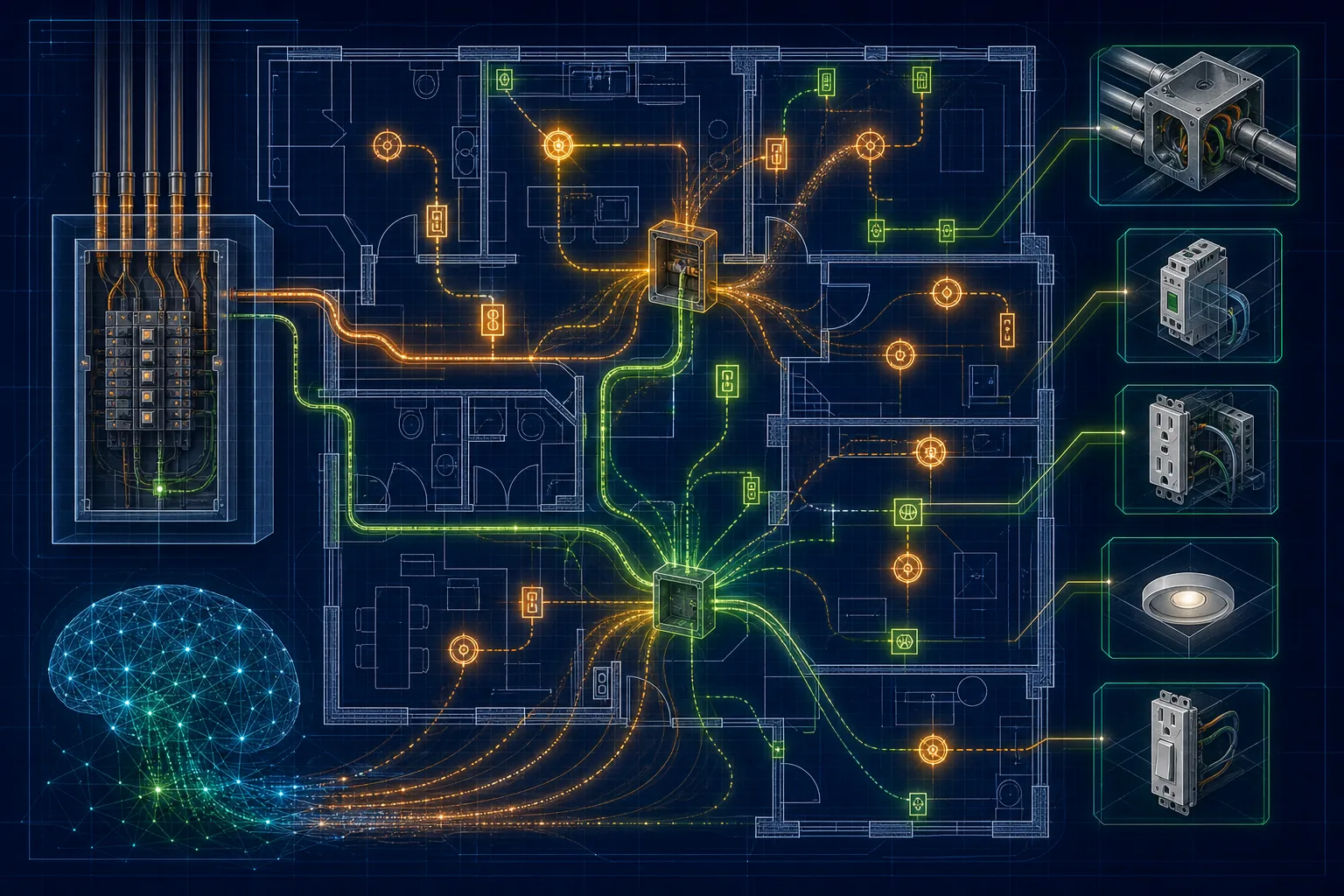
Think of electrical takeoff as a stack. Most tools only solve the bottom layer.
Layer 5: Priced Estimate        ← labor rates, margin, vendor pricing
Layer 4: Assembly Expansion     ← device → full material + labor BOM
Layer 3: Conduit & Wire         ← raceway type, conductor size, run length
Layer 2: Panel & Circuit Logic  ← breaker distribution, feeder sizing
Layer 1: Device Extraction      ← symbol recognition, counting, classification
Symbol counting lives at Layer 1. The best electrical takeoff software in 2026 operates across Layers 2 through 4 — with Layer 5 remaining estimator-controlled.
Our earlier technical walkthrough, From Symbol Count to Bid-Ready Estimate, covers Aginera's full pipeline. This article focuses on the assembly inference problem specifically: how AI connects the dots between symbols, schedules, and code-aware scope on 2D plans.
Why Symbol Counting Alone Fails Commercial Bids
Consider a typical commercial tenant improvement: 40 sheets of electrical drawings, three panel schedules, a lighting fixture schedule, and a low-voltage plan.
A symbol counter produces:
| Item | Quantity |
|---|---|
| Duplex receptacle | 142 |
| Decora switch | 67 |
| 2x4 recessed troffer | 218 |
| Exit sign | 14 |
| Junction box | 0 (not counted) |
| EMT conduit | 0 (not measured) |
| THHN wire | 0 (not calculated) |
An estimator looking at that list knows it is incomplete. The receptacles need boxes, cover plates, and device assemblies. The troffers need whips, supports, and circuit connections. The exit signs need emergency circuits and battery backup specifications. None of that appears in a pure symbol count.
Commercial electrical bids fail not because estimators miscount devices — though that happens — but because assembly scope is underdeveloped. AI assembly inference targets that gap directly.
How AI Classifies Electrical Sheets Before Extraction
A 150-page construction PDF is not one drawing. It is a structured document where each sheet type requires different extraction logic.
Before any symbol is counted, AI electrical takeoff software classifies each page:
| Sheet Pattern | Drawing Type | Extraction Focus |
|---|---|---|
| E-1xx | Power plans | Receptacles, panels, conduit routing |
| E-2xx | Lighting plans | Fixtures, switches, emergency egress |
| E-3xx | Fire alarm | Initiating devices, notification appliances |
| E-4xx | Low voltage / telecom | Data, security, AV devices |
| E-5xx | Panel schedules | Breaker tables, circuit descriptions |
| E-6xx | One-line / riser | Distribution topology, feeder sizing |
Routing each sheet to a specialized extraction model is the first step toward assembly inference. A lighting plan extractor knows to look for fixture types, switching groups, and circuit designations. A panel schedule extractor knows to parse tabular data — not count symbols.
This sheet classification approach is the same principle behind intelligent page routing for AI takeoff accuracy, applied specifically to electrical discipline documents.
Layer 2: Panel Schedule Parsing and Circuit Logic
Panel schedules are the Rosetta Stone of electrical drawings. A single schedule table for panel LP-2A encodes:
- Every branch circuit's breaker size and pole count
- Connected load descriptions
- Phase assignments (A, B, C)
- Main breaker rating and bus ampacity
- Voltage configuration
AI reads these tables using a combination of OCR and table-structure recognition. For each circuit row, the system extracts structured data:
| Circuit | Breaker | Poles | Description | Phase |
|---|---|---|---|---|
| 1 | 20A | 1 | Lighting - Corridor 2nd FL | A |
| 3 | 20A | 1 | Receptacles - Office 201-204 | B |
| 5 | 30A | 2 | HVAC Unit - RTU-2 | A,B |
| 7 | 20A | 1 | Emergency Lighting - 2nd FL | C |
This circuit map becomes the backbone for assembly inference. When the AI later finds receptacles on the power plan tagged to circuit 3, it can connect those devices to a 20A single-pole breaker on phase B — without the estimator manually cross-referencing the schedule.
What circuit logic enables
- Wire sizing inference — NEC ampacity rules applied to breaker size
- Conduit fill calculations — conductor count and size determine raceway diameter
- Load aggregation — connected load totals for feeder sizing validation
- Emergency circuit identification — egress and life safety devices routed separately
Layer 3: Conduit and Wire Inference from 2D Plans
Conduit is the hardest quantity to extract from 2D plans because it is often shown as lines that represent routing intent, not exact field paths.
AI electrical takeoff software approaches conduit inference through multiple signals:
- Visible routing lines — traced on plans with scale applied for length
- Circuit home runs — inferred paths from device clusters to panel locations
- Schedule-implied routing — feeder sizes from one-line diagrams mapped to riser paths
- Typical detail references — standard installation details that specify raceway type
The output is not a perfect field layout. It is a reviewable first-pass estimate of conduit quantities by type and diameter:
| Raceway Type | Size | Estimated LF | Source |
|---|---|---|---|
| EMT | 3/4" | 847 | Plan trace + home run inference |
| EMT | 1" | 312 | Feeder from panel LP-2A |
| MC Cable | 12/2 | 1,240 | Lighting branch circuits |
| Rigid | 2" | 86 | Site conduit (note reference) |
Estimators adjust these quantities based on field experience, building construction type, and coordination with other trades. The value is starting at 847 LF — not zero.
Layer 4: Assembly Expansion — Device to Full BOM
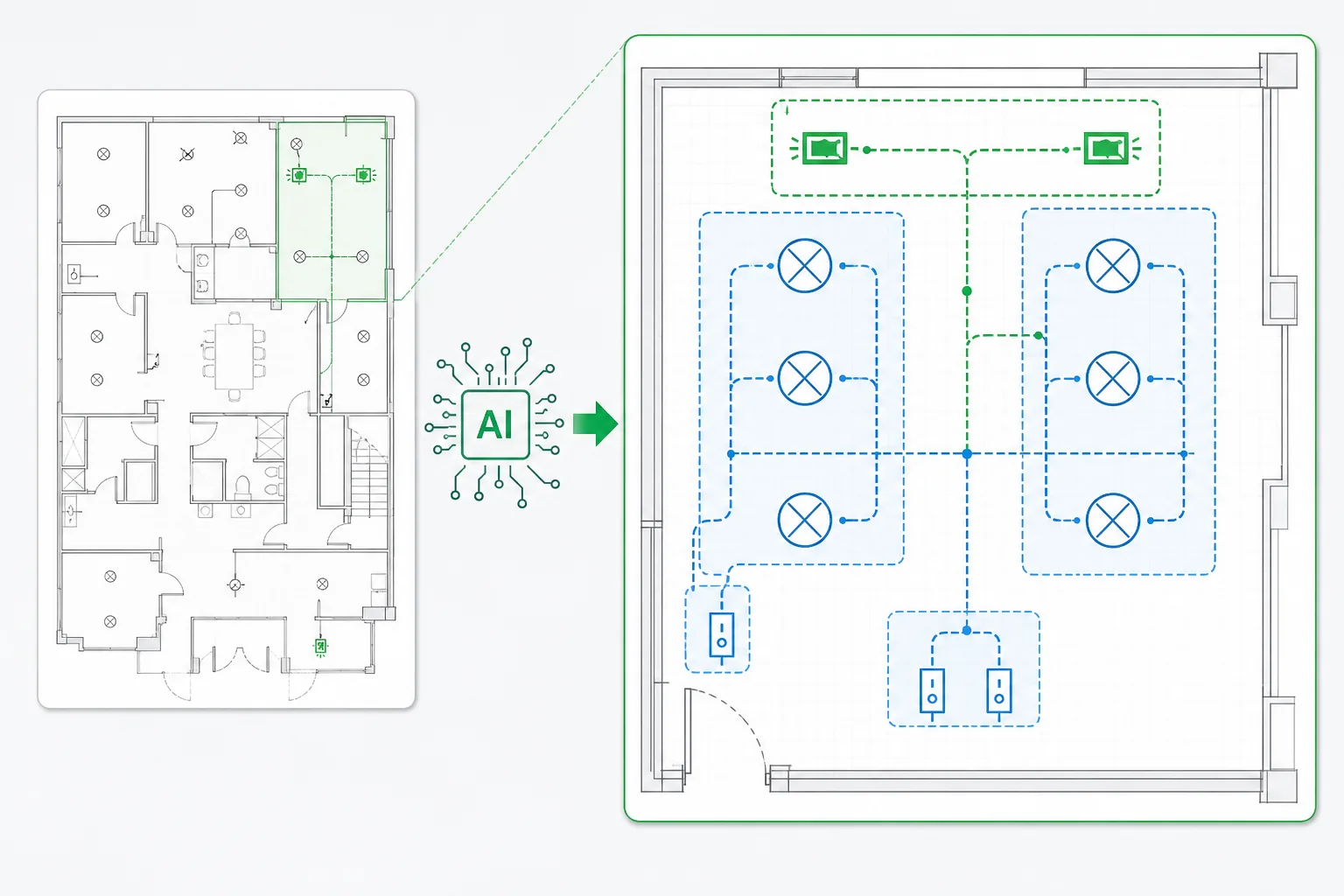
Assembly expansion is where AI electrical takeoff software delivers the most leverage over manual methods.
Each extracted device maps to a configurable assembly:
Duplex receptacle assembly example:
| Component | Quantity per Device | Unit |
|---|---|---|
| Duplex receptacle (spec grade) | 1 | EA |
| 4" square box (1-1/2" deep) | 1 | EA |
| Mud ring | 1 | EA |
| Cover plate | 1 | EA |
| #12 THHN (hot) | 45 | LF |
| #12 THHN (neutral) | 45 | LF |
| #12 THHN (ground) | 45 | LF |
| 3/4" EMT | 45 | LF |
| Connectors and couplings | 2 | EA |
| Labor — device install | 0.75 | HR |
Multiply by 142 receptacles and the assembly produces hundreds of line items that no symbol counter would generate.
Assembly types AI can infer
- Standard device assemblies — receptacles, switches, sensors
- Lighting assemblies — troffers with whips, supports, and drivers
- Emergency egress assemblies — exit signs with battery backup and dedicated circuits
- Panel terminations — breaker, lug, and grounding connections
- Low-voltage rough-in — boxes, cable, and faceplates for data/security devices
The assembly library should be estimator-configurable. Different contractors use different material standards, labor productivity rates, and preferred manufacturers. AI proposes the expansion; the estimator owns the final assembly definitions.
Handling the Hard Cases: Notes, Details, and Code Scope
Assembly inference breaks down when scope lives in text rather than symbols. Strong AI electrical takeoff software handles these cases by surfacing them for review — not by silently ignoring them or inventing quantities.
Engineer notes
A note reading "Provide GFCI protection for all receptacles within 6 feet of sink" does not add a new symbol to the plan. AI should:
- Detect the note
- Flag affected receptacles based on spatial proximity (when plan scale allows)
- Surface a review item: "Verify GFCI scope per note E-001-3"
Detail references
Keyed details show installation methods — box mounting heights, conduit support spacing, fire-rated penetrations. AI extracts the detail reference and links it to affected devices without automatically pricing labor factors the estimator may want to adjust.
Code-aware scope
NEC requirements for working clearances, dedicated circuits, and emergency systems often appear in specifications rather than plans. AI can cross-reference specification sections with extracted device types to flag potential code scope — but the estimator confirms applicability.
This review-first approach aligns with what experienced estimators ask for in AI MEP takeoff software evaluations: separate plan-confirmed quantities from items that need human judgment.
AI Electrical Takeoff vs. Free Tools: What You Actually Get
Search trends show contractors comparing AI electrical estimating software free options against paid platforms. The comparison usually misses the assembly layer.
| Capability | Spreadsheet / Free Tools | AI Electrical Takeoff Software |
|---|---|---|
| Symbol counting | Manual | Automated across full drawing set |
| Panel schedule parsing | Manual transcription | Automated table extraction |
| Conduit measurement | Manual trace (if any) | AI-inferred with review |
| Assembly expansion | Manual lookup tables | Configurable auto-expansion |
| Multi-sheet correlation | Estimator memory | Cross-sheet circuit linking |
| Addendum delta | Manual re-count | Automated revision comparison |
| Time for 100-sheet set | 2–4 days | Hours of review |
Free tools and spreadsheets are not wrong for small projects. For commercial and industrial electrical contractors bidding on drawing sets with thousands of devices, the assembly inference gap is where bids are won or lost.
Our comparison of best electrical takeoff software in 2026 covers the full landscape of options.
Spatial Context: Why 2D Extraction and 3D Visualization Work Together
Electrical assembly inference operates on 2D plans because that is what contractors bid from. But spatial context still matters — especially for conduit routing, ceiling height assumptions, and coordination with other trades.
Teams increasingly combine:
- 2D AI extraction for device counts, schedules, assemblies, and conduit quantities
- 3D spatial tools for layout verification and client presentations
If you need to validate room geometry or explore spatial relationships in a floor plan, Aginera's free Floor Plan to 3D converter converts PDF floor plans into interactive 3D models. It complements — rather than replaces — the electrical extraction pipeline that produces assembly-level takeoff data.
Queries like "convert pdf floor plan to 3d free" reflect real demand for spatial tools. The contractors who combine spatial verification with assembly-level extraction get both accuracy and speed.
Evaluating AI Electrical Takeoff Software: Questions to Ask
Before adopting any platform, ask these assembly-specific questions:
Extraction depth
- Does it parse panel schedules into structured circuit data?
- Does it infer conduit runs, or only count devices?
- Can it expand devices into configurable material assemblies?
Review workflow
- Does it separate plan-confirmed quantities from review-required items?
- Can estimators adjust assemblies without breaking the extraction link?
- Does it show source references (sheet, schedule row, note) for every line item?
Output quality
- Can you export to CSV/Excel formats compatible with Accubid, ConEst, McCormick, or Sage?
- Does the export include assembly breakdowns, not just top-level device counts?
- Can you extract BOM from PDF and hand it to procurement without reformatting?
Accuracy and transparency
- Does the platform flag low-confidence extractions?
- Can you see which inference rules produced a given conduit run or assembly line?
- Does it handle addenda and revision deltas?
What Aginera's Electrical Pipeline Does Today
Aginera's electrical extraction pipeline covers Layers 1 through 4 of the scope stack:
- Sheet classification — routes each page to the correct electrical extraction model
- Device extraction — symbols, fixtures, panels, and low-voltage devices with garbage filtering
- Panel schedule parsing — circuit tables with breaker size, description, and phase data
- Conduit and wire inference — raceway quantities from plan traces and circuit logic
- Assembly expansion — configurable device-to-material BOM generation
- Review workflow — plan-confirmed vs. review-required scope separation
The platform is designed for estimator-controlled AI: the system extracts and organizes; the estimator validates, adjusts, and owns the bid.
For a deeper technical walkthrough of each layer, see From Symbol Count to Bid-Ready Estimate.
Conclusion
The era of AI electrical takeoff software that only counts symbols is ending. In 2026, the best AI electrical estimating software infers assemblies — connecting devices to circuits, circuits to conduit, and conduit to the material lists that estimators actually price.
Symbol counting is necessary. It is not sufficient.
The contractors who adopt assembly-level extraction will bid faster, catch scope gaps earlier, and spend estimator time on judgment calls — existing conditions, substitution strategy, labor factors — instead of clicking through 150 sheets counting the same receptacle symbol for the third time this week.
Frequently Asked Questions
What is the difference between symbol counting and AI electrical assembly inference?
Symbol counting identifies and tallies device symbols on a plan — for example, 47 duplex receptacles. Assembly inference connects those symbols to panel circuits, conduit runs, wire sizes, junction boxes, and labor assemblies to produce a bid-ready material and scope list.
Can AI read panel schedules and connect them to plan symbols?
Yes. Advanced AI electrical takeoff software parses panel schedule tables to extract breaker sizes, circuit descriptions, and phase assignments, then correlates that data with devices shown on power and lighting plans.
How does AI infer conduit runs from 2D plans?
AI traces visible conduit routing on plans, applies scale to estimate run lengths, and combines circuit logic from panel schedules to infer home runs, branch circuits, and feeder paths. Estimators review and adjust inferred runs before pricing.
Is AI electrical takeoff software accurate enough for commercial bids?
AI electrical takeoff software produces a strong first-pass extraction that estimators review and refine. It is most accurate on plan-confirmed symbols and schedule data. Note-only scope, existing conditions, and field-specific assumptions still require human judgment.
How does AI electrical takeoff compare to free spreadsheet methods?
Spreadsheets require manual counting and assembly expansion. AI electrical takeoff software automates symbol recognition, schedule parsing, and assembly inference across full drawing sets — reducing days of manual work to hours of review. Free tools handle counting; AI platforms handle the full extraction pipeline.