Quantity Takeoff with AI: How Automated Material Extraction Works and Why It Matters
Every construction bid starts in the same place: someone sits down with a set of drawings and starts counting. Receptacles. Light fixtures. Lengths of conduit. Duct runs. Pipe fittings. This process — the quantity takeoff — is where estimators spend the majority of their time, and where the accuracy of every downstream number is determined.
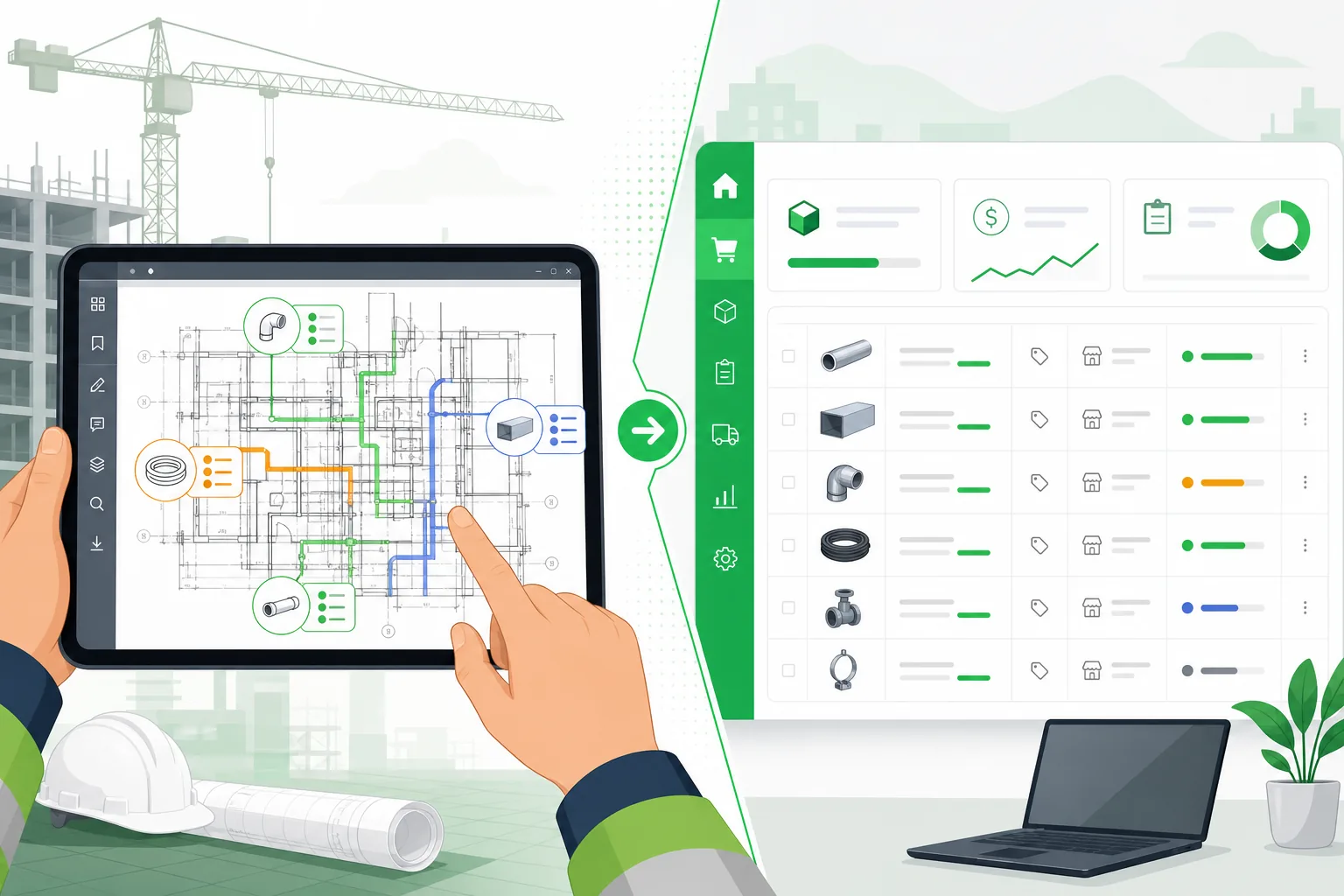
It is also where AI is having the most measurable impact on construction workflows today. This guide explains what a quantity takeoff is, how the process has evolved from paper to AI, and what automated material extraction actually looks like in practice.
What Is a Quantity Takeoff?
A quantity takeoff (sometimes called a QTO) is the process of measuring and counting all the materials, components, and labor items required for a construction project by analyzing the project's drawings, plans, and specifications.
The term "takeoff" comes from the act of "taking off" quantities from the drawings — extracting what is shown on paper and converting it into a list of materials with measurable quantities. Every construction trade performs some version of this process, whether the project is a single-family home or a 500,000-square-foot data center.
A quantity takeoff answers a straightforward question: what exactly needs to be built, and how much of each material is required?
The output is typically a structured list of items with quantities and units of measure:
| Item | Quantity | Unit |
|---|---|---|
| Duplex receptacle, 20A, spec grade | 142 | EA |
| 2x4 LED troffer, 40W | 87 | EA |
| 3/4" EMT conduit | 3,450 | LF |
| #12 THHN copper conductor | 18,600 | LF |
| 4" PVC sanitary pipe | 1,280 | LF |
| 24x12 galvanized duct | 860 | LF |
This list becomes the foundation for pricing, procurement, scheduling, and every other downstream construction management activity. If the takeoff is wrong, the estimate is wrong. If the estimate is wrong, the bid is wrong — and the contractor either loses the job or wins it at a loss.
Why Quantity Takeoff Matters So Much
The takeoff is not just a preliminary step. It is the single most consequential activity in the estimating process for three reasons:
-
Everything downstream depends on it. Material costs, labor hours, equipment needs, subcontractor scopes, and project schedules all derive from takeoff quantities. A 10% error in the takeoff cascades into a 10% error in the bid.
-
It consumes the most time. Industry surveys consistently show that quantity takeoff accounts for 60-70% of total estimating time on commercial projects. For a mid-size MEP contractor bidding 8-10 projects a month, that translates to hundreds of hours.
-
It determines bid capacity. The number of projects a firm can bid is directly limited by how fast their estimators can complete takeoffs. When each takeoff takes 2-3 days, a firm with two estimators can realistically bid only 8-12 projects per month — regardless of how many invitations arrive.
The Traditional Quantity Takeoff Process
Before understanding how AI changes the quantity takeoff, it is worth documenting what the traditional process involves. Whether performed on paper or using on-screen software, the fundamental steps are the same.
Step 1: Drawing Review and Organization
The estimator receives a drawing set — sometimes 50 pages, sometimes 500. The first task is to review every sheet, identify which ones are relevant to their trade, and organize them by system or area. An electrical estimator skips the structural and architectural sheets (mostly) and focuses on E-series drawings. A mechanical estimator focuses on M-series drawings.
This sounds simple, but on a complex project with multiple buildings, phases, and addenda, just organizing the drawings can take 1-2 hours.
Step 2: Component Identification and Counting
The estimator examines each relevant sheet and identifies every component that falls within their scope. For an electrical takeoff, this means counting every receptacle, switch, light fixture, panel, transformer, junction box, fire alarm device, and low-voltage component shown on the plans.
This step requires significant domain knowledge. The estimator must:
- Recognize hundreds of different symbols and what they represent
- Distinguish between similar symbols (a weatherproof receptacle vs. a standard receptacle)
- Read the legend and match non-standard symbols to their descriptions
- Cross-reference detail sheets and enlarged plans
- Account for items shown on multiple sheets without double-counting
For a 150-page commercial project, device counting alone can take 4-8 hours.
Step 3: Linear and Area Measurement
Not everything in a takeoff is counted by the each. Conduit, wire, pipe, and ductwork are measured in linear feet. Insulation, flooring, and ceiling materials are measured in square feet. The estimator must scale and measure these runs from the drawings.
On paper plans, this involves a physical scale ruler or a rolling measuring tool (digitizer). On digital plans, the estimator clicks two endpoints for each measurement. Either way, it is tedious — a single floor may have hundreds of individual conduit runs to measure.
Step 4: Specification Cross-Referencing
Drawings show what goes where, but specifications define what materials to use. The estimator reads the project specifications to determine material grades, manufacturer requirements, installation standards, and testing requirements. A receptacle shown on the drawing might need to be hospital-grade, tamper-resistant, or a specific color depending on what the spec says.
Step 5: Quantity Compilation
After counting and measuring, the estimator compiles all quantities into a structured format — typically a spreadsheet organized by CSI division, system, or area. This compilation step includes applying waste factors, accounting for fittings and accessories, and rolling up quantities from individual sheets into project totals.
Step 6: Quality Assurance
A good estimator checks their work. They compare quantities per square foot against historical benchmarks. They verify that device counts are reasonable for the building type and size. They look for entire systems that might have been missed. This QA step catches errors, but it takes additional time — and it depends entirely on the estimator's experience and attention to detail.
Total Time for Traditional Quantity Takeoff
For a commercial MEP project with 100-200 drawing pages, a traditional quantity takeoff typically takes:
| Phase | Time (Hours) |
|---|---|
| Drawing review and organization | 1-2 |
| Component identification and counting | 4-8 |
| Linear and area measurement | 4-8 |
| Specification cross-referencing | 2-3 |
| Quantity compilation | 2-3 |
| Quality assurance | 1-2 |
| Total | 14-26 hours |
At a loaded estimator cost of $75-100/hour, a single takeoff costs $1,050-$2,600 in labor. A firm bidding 10 projects a month spends $10,000-$26,000 on takeoff labor alone.
Four Generations of Quantity Takeoff Methods
The quantity takeoff process has evolved through four distinct generations, each reducing time and improving consistency.
Generation 1: Manual Paper Takeoff
The original method. Physical drawings spread across a table. A scale ruler, colored pencils, and a yellow legal pad. The estimator marks each item as it is counted, records quantities by hand, and transfers totals to a spreadsheet or estimate form.
Pros: No software cost. Works anywhere. Familiar to experienced estimators. Cons: Extremely slow. Error-prone (miscounts, transcription errors). No audit trail. Difficult to update when addenda arrive. Quantities trapped in one person's notes.
Generation 2: Digitizer-Based Takeoff
Digitizing tablets (large electronic boards connected to a computer) allowed estimators to place physical plans on the tablet and use a stylus to count items and trace linear measurements. The digitizer software recorded each click and automatically accumulated quantities.
Pros: Faster than fully manual counting. Automatic accumulation. Better audit trail. Cons: Expensive hardware. Requires physical prints. Cumbersome for large drawing sets. Still fundamentally manual — the estimator identifies and clicks every item.
Generation 3: On-Screen Digital Takeoff
Software tools like PlanSwift, On-Screen Takeoff, and Bluebeam Revu moved the process to a computer screen. Estimators work with digital PDFs, using mouse clicks to count items and trace linear measurements. This generation also introduced features like area measurement, condition-based sorting, and Excel integration.
Pros: No physical prints needed. Faster than digitizer. Better organization and reporting. Integrates with estimating software. Supports overlays and markup for team review. Cons: Still manual identification and clicking. Each component must be visually identified and individually counted by the estimator. A 150-page drawing set still requires the estimator to examine every page. Typical time savings vs. paper: 30-40%.
Generation 4: AI-Powered Quantity Takeoff
AI quantity takeoff software uses computer vision, natural language processing, and domain-specific engineering rules to automate the identification, counting, measuring, and classification of components. Instead of the estimator examining each drawing and clicking on each component, the AI reads the entire drawing set and produces a structured takeoff.
Pros: 70-90% reduction in takeoff time. Processes entire drawing sets, not single pages. Consistent — does not get fatigued or distracted. Handles addenda by reprocessing changed sheets. Creates a complete audit trail showing exactly where each quantity was extracted. Cons: Requires well-drawn plans (garbage in, garbage out). May struggle with unusual or non-standard symbology. Needs human QA review — AI is a tool, not a replacement for engineering judgment.
How AI Quantity Takeoff Works
Understanding AI quantity takeoff requires looking at each stage of the pipeline — from raw drawing input to structured takeoff output.
Drawing Ingestion and Classification
The process begins when a drawing set is uploaded. AI takeoff software accepts PDFs, DWG/DXF CAD files, and sometimes Revit models. The system first classifies each sheet by discipline: electrical power plans, lighting plans, mechanical HVAC plans, plumbing plans, fire protection plans, architectural floor plans, and so on.
Sheet classification matters because different disciplines require different extraction models. An electrical plan uses different symbology than a plumbing plan. A mechanical riser diagram requires different analysis than a floor plan layout. By classifying sheets first, the AI routes each page to the right extraction pipeline.
Symbol Recognition and Component Identification
Once sheets are classified, computer vision models scan each page to identify components. These models are trained specifically on construction drawing symbology — not general-purpose image recognition.
For an electrical lighting plan, the AI identifies:
- Recessed downlights, troffers, strip lights, exit signs, emergency fixtures
- Switching groups and control zones
- Circuiting information (home run designations, circuit numbers)
For a plumbing plan, it identifies:
- Fixtures (toilets, lavatories, sinks, floor drains)
- Pipe sizes and materials
- Valves, cleanouts, and access points
For a mechanical plan, it identifies:
- Diffusers, grilles, and registers
- VAV boxes and terminal units
- Equipment (AHUs, RTUs, exhaust fans)
- Duct sizes and transitions
Each identified component is classified by type and tagged with attributes extracted from the drawing: size, specification reference, circuit number, system designation, and location.
Quantity Calculation and Measurement
After identifying components, the AI calculates quantities using the appropriate unit of measure for each item:
-
Count items (EA): Receptacles, fixtures, devices, valves, diffusers — anything placed as a discrete unit. The AI counts instances across all relevant sheets, handling duplicates where the same item appears on multiple drawings (site plan, floor plan, enlarged plan).
-
Linear items (LF): Conduit, wire, pipe, ductwork — anything that runs as a continuous length. The AI traces these runs on the drawing, calculating total lengths including vertical rises and drops where shown.
-
Area items (SF): Insulation, ceiling systems, flooring — anything measured by surface area. The AI identifies bounded regions and calculates enclosed areas.
-
Volumetric items (CY): Concrete, excavation, fill — anything measured by volume. These are computed from area and depth dimensions shown on the drawings.
Schedule and Specification Parsing
Construction drawings contain more than floor plans. Panel schedules list every circuit and its connected load. Equipment schedules describe each piece of mechanical equipment. Fixture schedules detail the manufacturer, model, and lamp type for every light fixture.
AI takeoff software reads these schedules — which are essentially structured tables embedded in the drawings — and cross-references them with the components identified on the floor plans. This cross-referencing is critical. A light fixture shown as a generic symbol on the floor plan might be a $50 commodity troffer or a $800 architectural pendant, and the difference is in the fixture schedule.
Structured Output
The final output of an AI quantity takeoff is a structured dataset — not just a flat list, but an organized takeoff that can be grouped by:
- CSI division (Division 26 Electrical, Division 23 HVAC, Division 22 Plumbing)
- System (power distribution, lighting, fire alarm, HVAC supply)
- Floor or area (Level 1, Level 2, Building A, Building B)
- Phase (Phase 1 shell, Phase 2 tenant improvement)
This structure allows estimators to review quantities at whatever level of detail they need — drilling into individual items or reviewing aggregate quantities per floor.
Quantity Takeoff vs. Material Takeoff vs. Bill of Materials
These three terms are related and often confused. Understanding the distinction matters for both communication and workflow.
Quantity Takeoff (QTO)
A quantity takeoff extracts what is shown on the drawings — the designed components and their quantities. It tells you that the project has 142 duplex receptacles, 87 light fixtures, and 3,450 linear feet of 3/4" EMT conduit. The QTO reflects the engineer's design.
Material Takeoff (MTO)
A material takeoff translates the design quantities into purchasable materials. A single duplex receptacle on the drawing becomes a list of materials: the receptacle device, a device plate, a 4" square box, a plaster ring, wire connectors, and mounting screws. A material takeoff "explodes" each design component into its constituent parts.
The relationship: one QTO line item often expands into 3-10 MTO line items.
Bill of Materials (BOM)
A bill of materials is the procurement-ready list with specific manufacturer part numbers, catalog numbers, supplier pricing, and order quantities (including waste factors and packaging units). The BOM is what actually gets sent to a distributor for pricing or purchase.
How They Flow Together
Drawing Set
    ↓
Quantity Takeoff (QTO)    → "142 duplex receptacles"
    ↓
Material Takeoff (MTO)    → receptacle + plate + box + ring + connectors (×142)
    ↓
Bill of Materials (BOM)   → Leviton 5320-WMP, 4-11/16" sq box, etc. with pricing
    ↓
Estimate / Bid
AI-powered takeoff platforms like Aginera can compress these steps. Instead of producing a bare QTO that the estimator must then manually expand into an MTO and BOM, the AI applies assembly rules to each extracted component — automatically generating the full material list with labor allowances. You can see this pipeline in action in our guide to building a BOM from construction drawings.
Quantity Takeoff Across Different Trades
While the fundamental process is the same, quantity takeoff looks different depending on the trade. Each discipline has its own symbology, units of measure, and material considerations.
Electrical Takeoff
Electrical takeoff is among the most complex because of the sheer number of distinct components and the interdependencies between them. An electrical takeoff typically includes:
- Power devices: Receptacles (dozens of types), switches, sensors, motor connections
- Lighting: Fixtures (often 20-40 different types per project), controls, emergency fixtures
- Distribution: Panels, transformers, switchgear, disconnects, motor control centers
- Raceways: Conduit (EMT, RGS, PVC, MC cable) in multiple sizes
- Conductors: Wire and cable, sized per NEC requirements
- Low voltage: Fire alarm, security, data/telecom, audio/visual
- Specialty systems: Lightning protection, grounding, surge protection
What makes electrical takeoff particularly challenging is that many items are not explicitly drawn. Conduit and wire quantities must be inferred from device locations and home-run designations. Junction boxes are required by code at specific intervals but may not be individually shown. These "inferred" quantities are where experienced estimators and AI extraction models provide the most value.
Mechanical / HVAC Takeoff
HVAC takeoff focuses on air distribution, hydronic piping, and equipment:
- Ductwork: Rectangular and round duct in various sizes, with fittings (elbows, tees, transitions)
- Air terminals: Diffusers, grilles, registers, each with specific throw patterns and CFM ratings
- Equipment: Air handling units, rooftop units, split systems, VRF units, exhaust fans
- Piping: Chilled water, hot water, refrigerant, condensate — each with different materials and sizing
- Controls: Thermostats, sensors, damper actuators, BMS points
- Insulation: Duct and pipe insulation, specified by thickness and material
Plumbing Takeoff
Plumbing takeoff includes:
- Fixtures: Water closets, lavatories, sinks, floor drains, roof drains, cleanouts
- Piping: Domestic water (hot and cold), sanitary waste, storm drainage, natural gas — each in different materials (copper, PVC, cast iron, CPVC, PEX)
- Valves and specialties: Isolation valves, check valves, PRVs, backflow preventers, expansion tanks
- Equipment: Water heaters, booster pumps, grease interceptors, sump pumps
Fire Protection Takeoff
Fire protection (sprinkler) takeoff is relatively standardized compared to other MEP trades:
- Sprinkler heads: Pendant, upright, sidewall, concealed — classified by hazard group and coverage area
- Piping: Black steel in various sizes, with fittings
- Hangers and supports: Calculated by pipe size and span
- Valves and trim: Control valves, inspectors test, FDC connections
- Equipment: Fire pump, jockey pump, tanks (if applicable)
Accuracy and Quality Assurance in AI Quantity Takeoff
No takeoff — whether manual or AI-powered — is perfect. The question is not whether errors exist, but how they are managed and minimized.
Where AI Excels
AI quantity takeoff is most accurate for tasks that are repetitive and rule-based:
- Counting discrete components. An AI that has been trained on electrical symbology will count every receptacle on a sheet with near-perfect accuracy. It does not lose count, get distracted, or forget to check the last page.
- Consistent measurement. Linear measurements are calculated mathematically from the drawing geometry, eliminating the variability of human scaling.
- Complete coverage. The AI processes every page in the drawing set. It does not skip sheets or overlook areas the way a tired estimator might at hour six of a marathon counting session.
- Handling revisions. When an addendum arrives, the AI reprocesses changed sheets and automatically updates quantities — a task that takes an estimator hours of recounting.
Where Human Review Remains Essential
AI needs human oversight for situations that require judgment or context beyond what is shown on the drawings:
- Ambiguous symbology. When a symbol is non-standard, partially obscured, or could represent multiple component types, a human estimator uses project context to make the right call.
- Scope interpretation. Deciding what is included in a particular scope of work — especially at the boundaries between trades — requires contractual understanding that AI does not possess.
- Value engineering alternatives. An experienced estimator might recognize that a designed system could be built more cost-effectively with different materials or methods. AI extracts what is shown; it does not second-guess the design.
- Site conditions. Drawings represent the design intent. Real-world conditions — existing infrastructure, access constraints, coordination with other trades — affect quantities in ways that drawings alone cannot capture.
The Review Workflow
The most effective approach treats AI as the first pass and the estimator as the reviewer and editor:
- AI processes the drawing set and produces a complete takeoff with confidence scores for each item.
- The estimator reviews high-level quantities against experience benchmarks (e.g., "for a 50,000 SF office, 142 receptacles is reasonable").
- The estimator examines flagged items — anything the AI was not confident about, or anything that deviates from expected ranges.
- The estimator makes adjustments for scope, site conditions, and value engineering.
- The final takeoff is a collaboration between AI speed and human judgment.
This workflow typically reduces total takeoff time by 70-85% compared to fully manual methods while maintaining or improving accuracy.
Integrating Quantity Takeoff with Pricing and Estimating
A quantity takeoff by itself is not an estimate. It is the input to an estimate. The value of a takeoff increases dramatically when it flows directly into pricing.
From Quantities to Costs
Once a takeoff is complete, each line item needs:
- Material cost: What does the item cost to purchase? This requires current pricing from distributors or a maintained price database.
- Labor hours: How long does it take to install? This is typically based on labor unit databases (NECA, Means, or company-specific rates) applied per unit of measure.
- Labor cost: Labor hours multiplied by the applicable labor rate (union scale, prevailing wage, or shop rate).
- Equipment cost: Any rental equipment or specialized tools required for installation.
Why Integration Matters
When the takeoff and pricing systems are separate, the estimator must manually transfer quantities from the takeoff tool into the estimating tool. This transfer step:
- Takes time (often several hours for a large project)
- Introduces transcription errors
- Creates version control problems when quantities change
- Breaks the audit trail between drawing and estimate
AI takeoff platforms that integrate directly with pricing engines eliminate this gap. The AI-powered takeoff pipeline reads the drawings, produces quantities, applies assembly expansion (turning a QTO into an MTO), and prices everything — in a single workflow.
Assembly-Based Estimating
The most efficient estimating workflows use an assembly-based approach. Instead of pricing each material component individually, the estimator (or the AI) applies a pre-built assembly to each takeoff item.
For example, a duplex receptacle assembly might include:
| Component | Quantity | Unit Cost | Extended |
|---|---|---|---|
| Receptacle, duplex, 20A, spec grade | 1 EA | $4.80 | $4.80 |
| Cover plate, nylon, 1-gang | 1 EA | $0.85 | $0.85 |
| Box, 4" square, 2-1/8" deep | 1 EA | $3.20 | $3.20 |
| Plaster ring, single gang | 1 EA | $1.10 | $1.10 |
| Wire connector, yellow | 3 EA | $0.15 | $0.45 |
| Labor: install receptacle assembly | 0.35 HR | $85.00 | $29.75 |
| Assembly total | $40.15 |
Multiply by 142 receptacles, and you have $5,701 for that single line item — material, labor, and fittings included. Assembly-based pricing turns a 142-line takeoff into a 142-click estimate.
Aginera's BOM extraction pipeline automates this assembly expansion, turning extracted quantities directly into priced assemblies with full material and labor breakdowns.
AI Quantity Takeoff for Different Markets
North America
In the United States and Canada, the construction industry has the highest adoption rate for AI takeoff technology. The drivers are clear: high labor costs for estimators ($75-120/hour loaded), competitive bidding environments that reward speed, and a shortage of experienced estimators as senior professionals retire.
The US market also benefits from relatively standardized drawing practices. While every architect and engineer has their own style, the use of standard symbology (IEEE/ANSI for electrical, ASHRAE for mechanical) gives AI models a consistent vocabulary to learn from.
Middle East and India
Rapidly growing construction markets in the Middle East and India present a different but equally compelling case for AI quantity takeoff. These markets are characterized by:
- Very large project scales. Infrastructure, industrial, and commercial projects in the GCC and India are often massive, with drawing sets exceeding 500 pages. Manual takeoff for projects of this scale can take weeks.
- Competitive bidding pressure. Contractors bidding on government and institutional projects face tight deadlines and thin margins. Speed is critical.
- Growing adoption of digital workflows. As these markets move from paper-based to digital construction management, AI takeoff represents an opportunity to skip the intermediate on-screen takeoff generation entirely.
- Multiple unit systems. Projects may use metric, imperial, or mixed units depending on the client, consultant, and country of origin. AI takeoff software that handles unit conversion automatically eliminates a common source of errors.
The fundamentals of quantity takeoff are universal. A receptacle is a receptacle whether the drawing was produced in Houston, Dubai, or Mumbai. The symbology may vary slightly, but the underlying process — identify, count, measure, compile — is the same everywhere.
Australia and UK
These markets share a strong tradition of quantity surveying — a professional discipline dedicated specifically to measurement and cost management. AI takeoff in these markets often serves quantity surveyors (QS professionals) rather than trade estimators, automating the measurement process that QS firms perform for general contractors and project owners.
Getting Started with AI Quantity Takeoff
Adopting AI for quantity takeoff does not require rethinking your entire estimating workflow. The most successful implementations follow a practical progression:
Start with a Single Trade
Choose the trade where takeoff consumes the most time or where you have the most volume. For most MEP contractors, this is electrical — it has the highest component count and the most complex interdependencies.
Run Parallel Comparisons
For the first several projects, run the AI takeoff alongside your normal process. Compare the results item by item. This builds confidence in the AI output and helps you understand where it excels and where it needs human adjustment.
Shift the Estimator's Role
As confidence grows, shift your estimators from quantity extraction to quantity review. Instead of spending 20 hours counting and measuring, the estimator spends 2-3 hours reviewing the AI output, making adjustments, and focusing on the judgment-intensive parts of the estimate that only a human can do.
Expand to More Trades and Integrate Pricing
Once one trade is running smoothly, expand to additional trades. Integrate the takeoff output with your pricing and estimating workflow so that quantities flow directly into cost calculations without manual transfer.
If you are ready to see how AI quantity takeoff works on your drawings, start with a free trial on Aginera. Upload a drawing set and see the extracted quantities in minutes.
Frequently Asked Questions
What is a quantity takeoff in construction?
A quantity takeoff (QTO) is the process of identifying and counting all materials, components, and items required for a construction project by analyzing the project drawings and specifications. It produces a structured list of everything that needs to be built, with quantities and units of measure. The takeoff is the foundation of every construction estimate — without accurate quantities, pricing and bidding cannot be reliable.
What is the difference between a quantity takeoff and a material takeoff?
A quantity takeoff extracts what is shown on the drawings — the designed components and their quantities. A material takeoff expands those design components into purchasable materials. For example, a quantity takeoff shows "142 duplex receptacles." A material takeoff expands each receptacle into all the materials needed to install it: the device, cover plate, box, ring, connectors, and so on. In practice, many people use the terms interchangeably, but the distinction matters when communicating between estimating, purchasing, and project management teams.
How does AI perform a quantity takeoff?
AI quantity takeoff software uses computer vision to read construction drawings, identify components (symbols, text labels, schedules), count discrete items, measure linear and area quantities, and produce a structured takeoff. The AI is trained on thousands of construction drawings to recognize the symbology specific to each trade. It processes an entire drawing set at once and produces results in minutes rather than hours or days.
Is AI quantity takeoff accurate enough to use for bidding?
AI quantity takeoff achieves high accuracy for symbol recognition and counting, typically matching or exceeding the accuracy of manual counting on well-drawn plans. However, no takeoff method — manual or AI — is perfect. The recommended workflow uses AI for the initial extraction and a human estimator for review, adjustment, and scope interpretation. This combined approach typically delivers better accuracy than either method alone, because the AI ensures nothing is missed while the human applies judgment and project context.
What types of drawings work best with AI takeoff software?
AI takeoff works best with clean, legible construction drawings that follow standard symbology conventions. PDFs exported from CAD software (vector PDFs) produce the best results because the drawing elements are crisp and precisely positioned. Scanned paper drawings (raster PDFs) also work but may produce lower accuracy depending on scan quality. CAD files (DWG/DXF) can be processed directly, preserving the full geometric and layer data from the original design.
Can AI handle takeoffs for all construction trades?
Current AI takeoff platforms handle MEP trades (electrical, mechanical, plumbing, fire protection) most effectively because these trades have well-defined symbology and countable components. Structural and architectural trades — which deal more with dimensional geometry, material specifications, and finish schedules — are supported by some platforms but with less automation. Civil and sitework takeoff, which relies heavily on grading plans and earthwork calculations, requires specialized tools. The technology is expanding to cover more trades with each generation of models.
How long does an AI quantity takeoff take compared to manual?
For a typical commercial project with 100-200 drawing pages, a manual quantity takeoff takes 14-26 hours. An AI-powered takeoff processes the same drawing set in 10-30 minutes for extraction, plus 2-4 hours for human review and adjustment. Total time savings of 70-85% are typical. For very large projects (500+ pages), the time savings can exceed 90% because the AI scales linearly with page count while human fatigue causes manual takeoff time to scale exponentially.
Do I still need experienced estimators if I use AI for takeoffs?
Yes, absolutely. AI automates the extraction and counting work — the repetitive, time-intensive portion of estimating. Experienced estimators are still essential for scope interpretation, value engineering, bid strategy, client relationships, constructability review, and the dozens of judgment calls that turn a takeoff into a winning bid. What changes is how estimators spend their time: less counting, more thinking. The best firms use AI to free their senior estimators from grunt work so they can focus on the high-value decisions that win profitable projects.
Ready to see AI quantity takeoff in action? Start your free trial with Aginera and upload your first drawing set. The platform processes your drawings in minutes and produces a structured takeoff with full material breakdowns — no credit card required.
Related reading: Data center MEP estimating with AI takeoff · LEED certification and AI takeoff material quantities · Takeoff software comparison and pricing 2026 · Electrical takeoff software