MEP Takeoff Automation: How AI Reduces Estimation Time by 80% for Mechanical, Electrical, and Plumbing Contractors
An MEP takeoff is the foundation of every mechanical, electrical, and plumbing estimate. It determines what gets built, what gets bought, and what gets bid. It is also, by a wide margin, the most labor-intensive step in the estimating process.
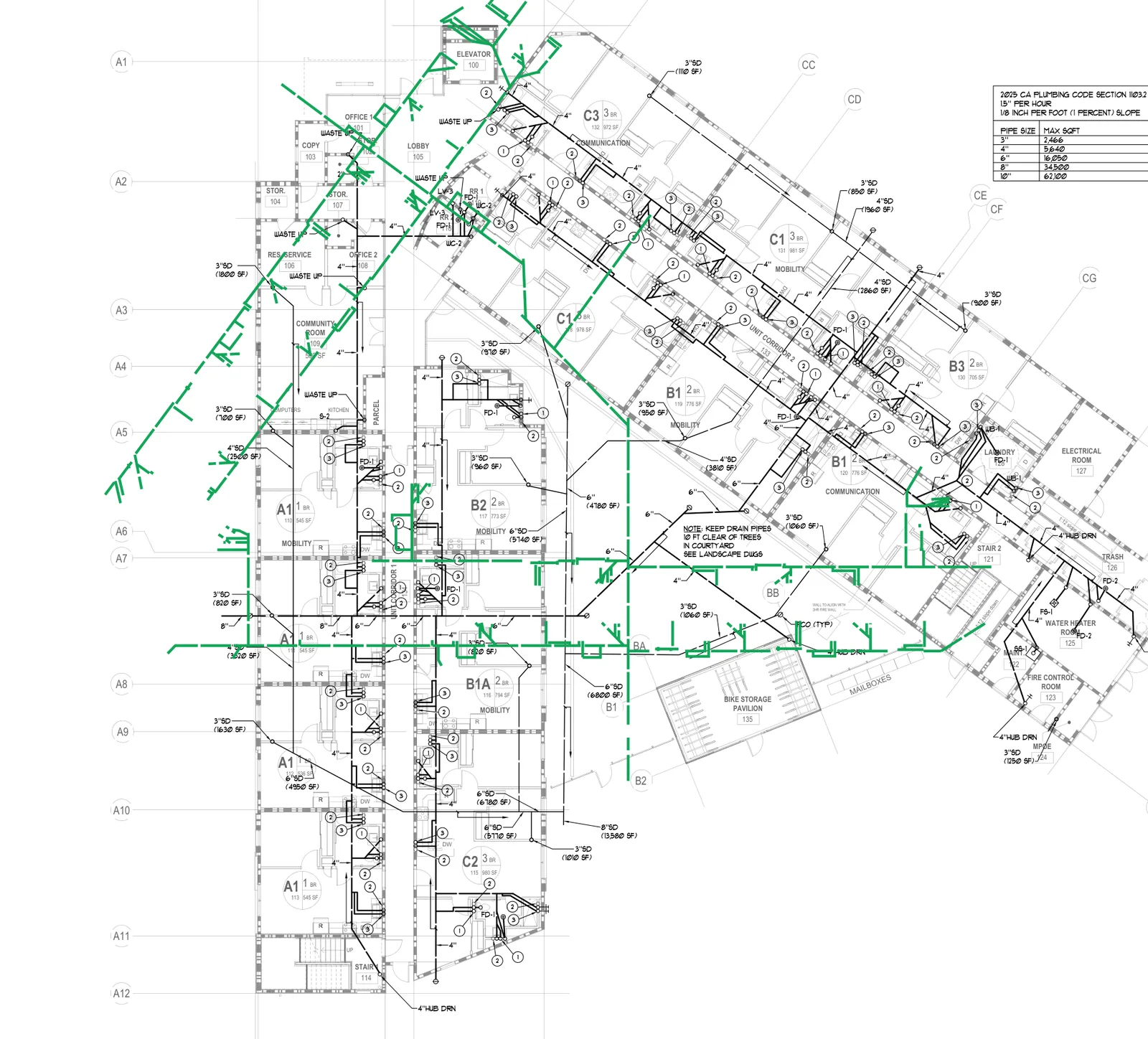
A mid-size commercial project — a 100,000 SF office building, a hospital wing, a data center — generates drawing sets with 200–400 pages across MEP disciplines. Inside those pages are thousands of components: receptacles, light fixtures, diffusers, VAV boxes, plumbing fixtures, sprinkler heads, miles of conduit and ductwork and piping. Extracting accurate quantities from those drawings is what separates a competitive bid from a losing one.
The problem is time. A full MEP takeoff for a commercial project consumes 40–80 hours of estimator time when done manually. That is an entire week of work per bid, per discipline. For contractors bidding 6–10 projects per month, the math does not work. You either hire more estimators (expensive and hard to find), or you leave bids on the table.
MEP takeoff software powered by AI changes the economics. Instead of an estimator spending days counting symbols and measuring runs, the AI processes the full drawing set in minutes — classifying sheets, recognizing components, parsing schedules, and producing structured takeoffs ready for pricing. This guide covers how AI-driven MEP takeoff automation works across all three disciplines, what it means for your estimating workflow, and how to evaluate whether it is right for your firm.
What Is an MEP Takeoff?
An MEP takeoff is the process of identifying and quantifying every material and component required for the mechanical, electrical, and plumbing scope of a construction project. It involves reading construction drawings (floor plans, riser diagrams, schedules, details) and producing a structured list of items with quantities, measurements, and specifications.
Unlike architectural or structural takeoffs that deal with relatively few component types, MEP takeoffs are uniquely complex because they span three distinct engineering disciplines, each with its own drawing conventions, component libraries, and estimation methodologies. A single commercial building may require separate takeoffs for:
- Electrical: Power distribution, lighting, fire alarm, low voltage, communications
- Mechanical/HVAC: Heating, ventilation, air conditioning, building automation
- Plumbing: Domestic water, sanitary waste, storm drainage, gas piping, specialty systems
Each discipline has components that must be counted (EA), measured linearly (LF), calculated by area (SF), or derived from schedules and specifications. The interplay between these disciplines — shared ceiling spaces, coordinated penetrations, sequenced installations — adds another layer of complexity that manual processes handle poorly.
The Three Disciplines: What Gets Counted, Measured, and Parsed
Electrical Takeoff
Electrical is the most component-dense MEP discipline. A single floor of a commercial building can have 200–500 individually identifiable devices on the power and lighting plans alone.
What gets counted (EA):
- Receptacles — standard duplex, GFCI, dedicated, isolated ground, floor-mounted
- Switches — single pole, three-way, dimmer, occupancy/vacancy sensors
- Light fixtures — LED troffers, downlights, linear strips, emergency lights, exit signs
- Fire alarm devices — smoke detectors, heat detectors, pull stations, horn/strobes, speakers
- Low voltage — data outlets, CCTV cameras, access control readers, WAPs, BDA/DAS antennas
- Distribution equipment — panelboards, transformers, disconnects, switchgear, transfer switches
What gets measured (LF):
- Conduit runs — EMT, rigid, PVC, flexible metal conduit
- Wire and cable — THHN, XHHW-2, MC cable, fire alarm cable, data cable
- Cable tray and wireway
- Feeders between distribution equipment
What schedules are parsed:
- Panel schedules — breaker sizes, pole counts, circuit descriptions, connected loads, voltage configurations
- Fixture schedules — fixture types, lamp counts, wattages, catalog numbers, mounting types
- Equipment schedules — transformer kVA ratings, disconnect sizes, ATS ratings
What assemblies are expanded: Every device expands into a full installation assembly. A single duplex receptacle becomes the device, box, cover plate, conduit (typically 20–35 LF of EMT), wire (three conductors per circuit), connectors, fittings, and installation labor. Conduit and wire quantities are inferred from panel schedules using NEC ampacity tables and conduit fill calculations — a step that accounts for 40–60% of the total electrical material cost.
For a deeper look at the electrical extraction pipeline, including panel schedule parsing, conduit inference, and NEC-compliant assembly expansion, see our technical deep dive on electrical takeoff automation.
Mechanical and HVAC Takeoff
Mechanical takeoffs revolve around air handling, temperature control, and the ductwork and piping that connects everything. The component density per sheet is lower than electrical, but the individual items are larger and more expensive — a single air handling unit can cost $50,000–$200,000.
What gets counted (EA):
- Air handling units (AHUs) — rooftop units, split systems, fan coil units, CRAC units
- Terminal units — VAV boxes, fan-powered boxes, chilled beams
- Diffusers and grilles — supply diffusers, return air grilles, linear slot diffusers, exhaust grilles
- Dampers — fire dampers, smoke dampers, volume dampers, backdraft dampers
- Controls — thermostats, temperature sensors, humidity sensors, CO2 sensors, actuators, control valves
- Pumps — chilled water, hot water, condensate, booster pumps
- Specialty equipment — energy recovery ventilators, humidifiers, duct heaters, VFDs
What gets measured (LF and SF):
- Rectangular ductwork — supply, return, exhaust, with width x height dimensions at each section
- Round/spiral ductwork — supply and exhaust with diameter at each section
- Duct insulation — interior liner or exterior wrap, measured by surface area (SF)
- Hydronic piping — chilled water, hot water, condenser water, with pipe diameter at each section
- Refrigerant piping — suction and liquid lines between condensing units and evaporators
- Condensate piping — from equipment to floor drains
What schedules are parsed:
- Equipment schedules — model numbers, CFM ratings, BTU capacities, electrical requirements, weights
- Diffuser schedules — sizes, CFM ratings, throw patterns, mounting types
- Fan schedules — CFM, static pressure, motor HP, electrical connections
- Control valve schedules — sizes, Cv ratings, actuator types
What assemblies are expanded: A VAV box on a drawing represents not just the unit itself, but the duct connections (supply and discharge), flex duct to diffusers, control wiring, thermostat, mounting hardware, and access provisions. Ductwork assemblies include the sheet metal, fasteners, sealant, hangers (one per 8–10 LF), insulation, and turning vanes for elbows. Hydronic piping assemblies include the pipe, fittings (elbows, tees, reducers), valves, insulation, hangers, and testing provisions.
Plumbing Takeoff
Plumbing takeoffs are driven by fixture counts and the piping networks that serve them. The fixture count determines the pipe sizing through DFU (drainage fixture unit) and WSFU (water supply fixture unit) calculations per the International Plumbing Code.
What gets counted (EA):
- Water closets — floor-mounted, wall-hung, sensor-flush, manual flush
- Lavatories — undermount, drop-in, wall-hung, ADA-compliant
- Urinals — wall-hung, waterless
- Sinks — kitchen, utility, mop, lab, scrub
- Water heaters — tank, tankless, point-of-use
- Drinking fountains and bottle fillers — wall-mounted, bi-level, ADA
- Specialty fixtures — floor drains, roof drains, cleanouts, hose bibbs, gas outlets, emergency eyewash/showers
- Valves — isolation valves, check valves, pressure reducing valves, backflow preventers, mixing valves, relief valves
- Equipment — grease interceptors, sump pumps, expansion tanks, water softeners, recirculation pumps
What gets measured (LF):
- Domestic water piping — hot and cold, copper or PEX or CPVC, with diameter at each section
- Sanitary waste piping — cast iron or PVC, with diameter per fixture group
- Vent piping — connecting waste piping to the building vent system
- Storm drainage piping — from roof drains to building storm sewer
- Natural gas piping — from meter to equipment (water heaters, boilers, kitchen equipment)
- Insulation — pipe insulation measured by linear foot and diameter
What schedules are parsed:
- Plumbing fixture schedules — model numbers, manufacturers, rough-in dimensions, connection sizes, ADA compliance
- Equipment schedules — water heater capacity (gallons, BTU), pump specs (GPM, head), interceptor sizing
- Riser diagrams — vertical distribution showing pipe sizes, floor connections, valves
What assemblies are expanded: A water closet on a drawing becomes the fixture, carrier (for wall-hung), flush valve or flushometer, supply stop, water supply connection (typically 1/2" copper), waste connection (typically 4" cast iron or PVC), vent connection, floor flange, wax ring, bolts, and installation labor. Pipe assemblies expand to include the pipe itself, fittings at every change of direction or branch, hangers (per code spacing requirements), fire-stopping at rated penetrations, insulation, and testing/commissioning labor.
Typical Component Counts for a Commercial MEP Project
To illustrate the scale of an MEP takeoff, here are representative component counts for a 100,000 SF Class A commercial office building:
| Component Category | Typical Count | Unit | Discipline |
|---|---|---|---|
| Duplex receptacles | 400–600 | EA | Electrical |
| Light fixtures (all types) | 800–1,200 | EA | Electrical |
| Fire alarm devices | 150–300 | EA | Electrical |
| Data/telecom outlets | 300–500 | EA | Electrical |
| Panelboards | 15–25 | EA | Electrical |
| Conduit (all sizes) | 15,000–25,000 | LF | Electrical |
| Wire and cable | 50,000–80,000 | LF | Electrical |
| VAV boxes | 40–80 | EA | Mechanical |
| Diffusers and grilles | 300–500 | EA | Mechanical |
| Air handling units | 4–8 | EA | Mechanical |
| Ductwork (all types) | 8,000–15,000 | LF | Mechanical |
| Hydronic piping | 3,000–6,000 | LF | Mechanical |
| Plumbing fixtures | 80–150 | EA | Plumbing |
| Domestic water piping | 4,000–8,000 | LF | Plumbing |
| Sanitary/vent piping | 3,000–6,000 | LF | Plumbing |
| Valves (all types) | 200–400 | EA | Plumbing |
| Sprinkler heads | 600–1,000 | EA | Fire Protection |
That is roughly 4,000–6,000 individually identifiable components across MEP disciplines, plus 80,000–140,000 linear feet of conduit, wire, ductwork, and piping. Manually counting and measuring these quantities from drawings is where the 40–80 hours disappear.
Manual MEP Takeoff vs. AI-Automated: A Time Comparison
The table below compares the time investment for a manual MEP takeoff against an AI-automated workflow on the same 100,000 SF commercial project:
| Takeoff Phase | Manual (All MEP) | AI-Automated | Time Saved |
|---|---|---|---|
| Sheet review and classification | 2–4 hours | Automated (seconds) | 2–4 hours |
| Electrical device counting | 6–10 hours | Automated (2–3 min) | 6–10 hours |
| Electrical conduit/wire measurement | 6–12 hours | Automated via inference | 6–12 hours |
| Panel schedule parsing | 2–4 hours | Automated (30 sec) | 2–4 hours |
| Mechanical equipment/duct takeoff | 6–10 hours | Automated (2–3 min) | 6–10 hours |
| Plumbing fixture/piping takeoff | 4–8 hours | Automated (1–2 min) | 4–8 hours |
| Quantity compilation into spreadsheets | 3–5 hours | Auto-structured | 3–5 hours |
| QA and cross-referencing | 3–5 hours | Confidence-based review: 1–2 hours | 2–3 hours |
| Total | 32–58 hours | 3–6 hours (review only) | 29–52 hours |
The AI handles extraction, counting, measurement, and compilation. The estimator's role shifts from production to review — verifying flagged items, applying judgment on specification ambiguities, and confirming assembly selections. This is higher-value work that leverages the estimator's experience rather than their patience.
Coordination Between MEP Trades
One of the most underappreciated challenges in MEP estimating is trade coordination. Electrical, mechanical, and plumbing systems share the same physical space — above ceilings, in shafts, within walls — and conflicts between these systems directly impact installation cost.
Ceiling Space Conflicts
A typical commercial ceiling plenum is 18–36 inches deep. Into that space must fit:
- Rectangular supply and return ductwork (often 12–18 inches deep)
- Conduit racks and cable tray
- Sprinkler branch piping
- Plumbing vent piping
- Lighting junction boxes and fixtures
- Fire alarm conduit and devices
When the ductwork on the mechanical drawing occupies the same elevation as the conduit rack on the electrical drawing, someone has to move. That move costs money — rerouting, additional fittings, longer runs, field coordination time.
How AI Helps with Trade Coordination
AI-powered MEP takeoff software that processes all disciplines from the same drawing set can identify potential coordination issues before they become field problems:
- Spatial overlap detection — flagging areas where ductwork routing on mechanical plans conflicts with conduit routing on electrical plans
- Shared penetration identification — recognizing where multiple trades need to penetrate the same wall, floor, or rated barrier
- Ceiling height validation — comparing the cumulative depth of all MEP systems against the available plenum space shown on architectural reflected ceiling plans
This does not replace full BIM-based clash detection, but it provides early warnings that help estimators include coordination allowances in their bids rather than absorbing them as change orders.
For firms working on complex multi-trade coordination, our MEP contractor solutions and MEP design firm tools address these workflows specifically.
How Addenda Impact MEP Takeoffs
Addenda are the bane of every estimator's existence, and MEP takeoffs are disproportionately affected.
Why MEP Is Hit Hardest by Addenda
An architectural addendum that changes a room layout triggers cascading changes across all MEP disciplines:
- Electrical: Receptacle and switch locations change. Lighting layout changes. Panel schedule circuit assignments change. Conduit routing changes.
- Mechanical: Diffuser locations change. Duct routing changes. VAV box assignments change. Thermostat locations change.
- Plumbing: Fixture locations change. Pipe routing changes. Riser connections may shift.
A single architectural revision can invalidate 30–50% of an MEP takeoff. With a manual process, the estimator has two options: re-do the entire takeoff (expensive) or try to surgically update only the changed items (error-prone).
AI-Powered Change Detection
This is where MEP takeoff software with built-in change detection pays for itself. When an addendum arrives, the AI compares the new drawing set against the previous issue and produces a delta report:
- Added components — new fixtures, devices, or equipment not in the previous issue
- Removed components — items that were on the previous drawings but are no longer shown
- Modified components — items where the type, size, or specification changed
- Unchanged components — items confirmed to be the same (the majority, typically 60–80%)
Instead of re-running a full MEP takeoff, the estimator reviews only the changes. On a typical addendum, this reduces the update effort from 8–16 hours to 30–60 minutes.
For a contractor bidding a project with three addenda — which is common on competitive public work — that is the difference between 24–48 hours of rework and 90 minutes.
ROI Calculation: MEP Takeoff Automation
The return on investment for MEP takeoff software has two components: direct labor savings and revenue from increased bid volume.
Direct Labor Savings
| Metric | Manual Process | AI-Automated | Delta |
|---|---|---|---|
| Hours per MEP takeoff | 45 hours | 5 hours (review) | 40 hours saved |
| Bids per month | 6 | 6 | — |
| Monthly takeoff hours (all MEP) | 270 hours | 30 hours | 240 hours saved |
| Blended estimator cost per hour | $85 | $85 | — |
| Monthly takeoff labor cost | $22,950 | $2,550 | $20,400 saved |
| Annual takeoff labor savings | $244,800 |
Increased Bid Volume
With 240 hours freed per month, the same estimating team can pursue more work:
| Metric | Manual Capacity | AI-Augmented Capacity |
|---|---|---|
| Full MEP bids per estimator per month | 3–4 | 10–15 |
| Team of 3 estimators: bids per month | 10–12 | 30–45 |
| Win rate | 20% | 20% |
| Projects won per month | 2–2.4 | 6–9 |
| Average MEP contract value | $800K | $800K |
| Monthly revenue pipeline | $1.6–1.9M | $4.8–7.2M |
The revenue multiplier is the real story. Direct labor savings of $20,000/month are meaningful, but the ability to triple or quadruple bid volume at the same headcount transforms the business. Even a modest improvement in win rate — because your team has more time for bid strategy and relationships — amplifies the impact further.
Break-Even Analysis
Most AI MEP takeoff software costs between $500–$2,000 per month per seat. Against monthly savings of $20,000+ and a revenue pipeline increase measured in millions, the break-even point is typically within the first week of use.
For detailed pricing on Aginera's MEP takeoff capabilities, visit our solutions for electrical estimating and mechanical estimating.
How Aginera Handles MEP Takeoff Automation
Aginera DesignOps is purpose-built for MEP and electrical contractors who need takeoffs that go beyond symbol counting. Here is what the workflow looks like:
Upload and Classify
Upload the full drawing set — PDF or CAD (DWG/DXF). The system classifies every sheet by discipline and type. Electrical power plans route to the electrical extraction model. Mechanical plans route to the HVAC model. Plumbing plans route to the plumbing model. Schedules route to the table parser. Architectural plans are retained as context for room identification and spatial reference.
Extract and Expand
Each discipline-specific model extracts components, counts devices, measures linear runs, and parses schedule tables. The assembly expansion engine then converts raw counts into bid-ready material and labor quantities — conduit and wire for electrical circuits, duct insulation and hangers for HVAC, fittings and valves for plumbing piping.
Review and Adjust
The takeoff appears in an organized, editable interface. High-confidence items (90%+) are auto-approved. Medium-confidence items are highlighted for quick verification. Low-confidence items are flagged for manual review. Your estimator focuses their time on the 5–10% that needs professional judgment.
Price and Bid
Apply your material pricing library and labor rates. The platform supports RS Means defaults, custom rate sheets, and vendor quote imports. Export to Excel, PDF, or integrate with your proposal system.
Learn more about how the full pipeline works in our post on AI-powered construction takeoffs and the future of estimating.
Getting Started with AI MEP Takeoff
If your firm estimates mechanical, electrical, or plumbing work and your team spends more time counting than pricing, MEP takeoff automation is the highest-leverage investment you can make.
The transition does not require replacing your workflow. It augments it. Your estimators still review every takeoff, still apply their judgment, still own the final number. They just stop spending 40 hours producing the raw quantities that a machine can extract in minutes.
Start your free trial of Aginera DesignOps and upload your next project's drawings. See the full MEP takeoff — electrical, mechanical, and plumbing — in minutes instead of days.
Frequently Asked Questions
What is an MEP takeoff?
An MEP takeoff is the process of identifying and quantifying all materials and components for the mechanical, electrical, and plumbing scope of a construction project. It involves reading project drawings and specifications to produce a structured list of items — devices, fixtures, equipment, conduit, ductwork, piping, and associated materials — with accurate quantities for pricing and bidding.
How long does a manual MEP takeoff take?
A full MEP takeoff for a mid-size commercial project (100,000 SF, 200+ drawing pages) typically requires 40–80 hours of estimator time when done manually — split roughly equally across the three disciplines. This includes sheet review, device counting, linear measurement, schedule parsing, quantity compilation, and quality assurance.
What MEP trades does AI takeoff software support?
Comprehensive MEP takeoff software supports all major MEP disciplines: electrical (power distribution, lighting, fire alarm, low voltage, communications), mechanical/HVAC (air handling equipment, ductwork, hydronic piping, controls), plumbing (fixtures, domestic water piping, sanitary waste, vent piping, storm drainage), and fire protection (sprinklers, standpipes, risers). Each discipline uses specialized extraction models trained on that trade's drawing conventions.
How does AI handle different drawing formats?
AI MEP takeoff software processes PDF drawings (the most common format for bid sets), CAD files (DWG/DXF, which preserve layer and block data for more precise extraction), and some platforms support Revit models (RVT) for BIM-level extraction. PDF processing uses computer vision to interpret the visual content. CAD processing leverages the structured data within the file — named blocks, layer assignments, and attribute data — for higher accuracy.
Can AI takeoff software handle addenda and revisions?
Yes. Advanced MEP takeoff platforms include change detection that compares a new revision against the previous drawing issue. The system identifies added, removed, and modified components across all MEP disciplines, producing a delta report so the estimator reviews only changes rather than re-running the full takeoff. This is critical given that most competitive bids receive 2–4 addenda before bid day.
Is MEP takeoff software accurate enough to replace manual counting?
AI MEP takeoff software achieves 90–95% accuracy with assembly expansion — comparable to or better than the 85–90% typical of manual takeoffs. The AI eliminates arithmetic errors, missed items from skimmed sheets, and forgotten assemblies. Human review catches the remaining items where the AI flags uncertainty, typically 5–10% of the total takeoff. The combination of AI extraction and human review produces the most accurate result.
What is the ROI of MEP takeoff automation?
For a firm with three estimators bidding six full MEP projects per month, AI takeoff automation saves approximately 240 estimator hours per month — roughly $20,000 in direct labor costs. More importantly, the freed capacity allows the same team to bid 3–4x more projects, which at a 20% win rate and $800K average contract value translates to millions in additional annual revenue pipeline. Most firms achieve payback within the first month.
How does MEP takeoff automation affect estimator roles?
MEP takeoff automation shifts the estimator's role from production to review and strategy. Instead of spending 80% of their time on quantity extraction (counting, measuring, compiling), estimators spend that time on higher-value activities: reviewing AI-flagged items, refining bid strategy, negotiating with suppliers, building relationships with GCs, and pursuing more opportunities. The estimator's domain expertise becomes more valuable, not less, because they apply it across more projects.