The U.S. Green Building Council's September 2025 note on data centers makes two points that matter to anyone estimating high-end construction. First, the load is real: data centers already consume over 4% of US electricity, and AI demand is expected to double or triple that by 2030. Second, owners are responding by certifying: LEED registrations for data centers grew 188% between 2021 and 2024, certifications grew 97%, and as of August 2025 more than 1,635 data centers — 489 million square feet — were certified through or registered with LEED. India, notably, has 61% of its certified data centers at Platinum.
The part of that story nobody writes about is who produces the numbers. Most of the LEED credits a contractor touches are quantity problems before they are sustainability problems — how many products, how much mass, from which sheets — and the quantity work lands on the same estimating desk that is already pricing the job. This post is about that overlap: which LEED credits start from a material takeoff, what a good quantity set for LEED looks like, and where an AI takeoff fits. It is also honest about where it does not.
The LEED credits that start from a takeoff
LEED does not award points for having a takeoff. But several credits cannot be documented without one.
Materials and Resources — Building Product Disclosure and Optimization (LEED v4.1 BD+C). Three credits under this heading — environmental product declarations, sourcing of raw materials, and material ingredients — are documented by counting permanently installed products from different manufacturers that meet the disclosure criteria, and by valuing compliant products as a share of total materials cost. You need a complete list of installed products with quantities and cost to know whether you have reached the threshold, and to prove it.
Materials and Resources — Building Life-Cycle Impact Reduction. The whole-building life-cycle assessment option compares the proposed structure and enclosure against a baseline across impact categories. The LCA tool needs quantities by material — concrete by volume and mix, steel by mass and section, insulation by area and type, and so on — for everything in scope.
LEED v5 — embodied carbon. The 2025 rating system moves embodied carbon from optional to expected: BD+C projects quantify embodied carbon as a prerequisite and earn credit for reducing it. That is a mass-by-material calculation multiplied by emission factors, and it is redone as the design changes.
Construction and Demolition Waste Management. Diversion is reported by mass or volume against a total; the total starts from the quantities in the drawings.
LEED BD+C: Data Centers. The data center adaptation adds IT-load and cooling-specific energy metrics, but its materials credits are the same, applied to a building whose embodied footprint is dominated by mechanical and electrical plant — switchgear, UPS, generators, chillers, cooling towers, busway, piping and cable — rather than by the shell.
In every case, the first deliverable is the same: a categorised, sourced, current list of what is in the building and how much of it there is.
What a LEED-usable quantity set looks like
A takeoff built for pricing is not automatically a takeoff usable for LEED. The certification team and, later, the reviewer, need four properties the bid spreadsheet often lacks:
- Categorised by material and product, not just by cost code. "Feeders — 12,400 LF" prices fine; the LCA needs copper mass by conductor size and the EPD credit needs the manufacturer and product line.
- Attributed to the sheet it came from. Reviewers ask. A line that links to the drawing sheet and region it was read from answers the question; a hand count from months ago does not.
- Complete across disciplines. Structure and enclosure carry the LCA; mechanical and electrical carry the product counts. A data center's embodied footprint lives in the plant.
- Current. The tally is only right until the next revision. Whatever produces it has to be cheap to re-run.
Those four properties are exactly what a manual takeoff struggles to provide at scale, and exactly what a structured extraction provides by default.
Where AI takeoff fits
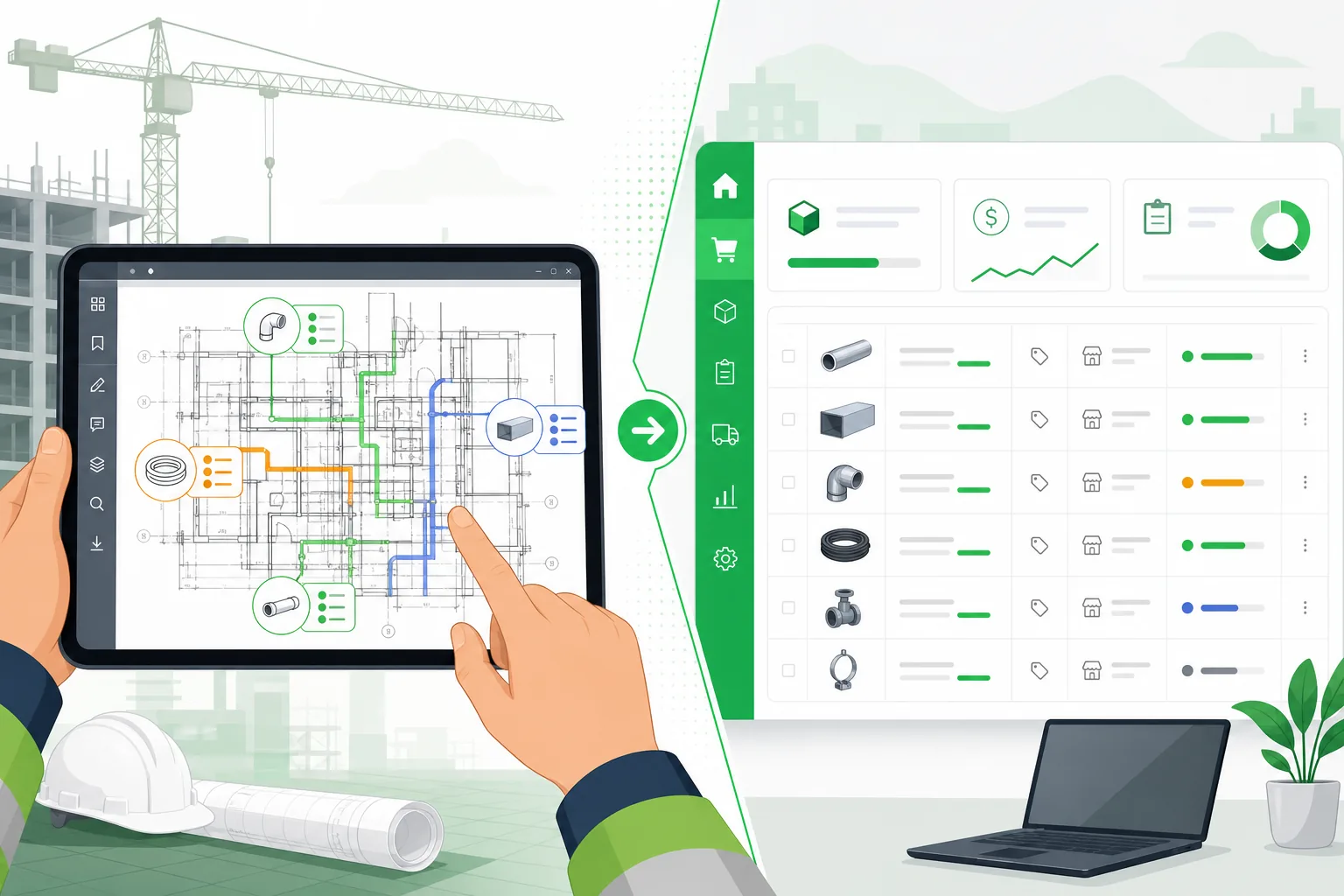
How Aginera reads a set is a staged pipeline: each sheet is classified by drawing type and extracted with a schema written for that type, the output is a list of items with quantity, unit, discipline and category, and each item keeps an evidence link back to the sheet and region it was read from. That design was built for estimating accuracy; it happens to produce a LEED-usable quantity set as a by-product.
Product counts for disclosure credits. Equipment and fixture schedules come out as tagged units with the manufacturer and model printed on the sheet where the drawings carry them, and as typed items where they do not. The LEED consultant's job becomes matching a list against the EPD and HPD registries, not building the list.
Mass by material for LCA and embodied carbon. Structural quantities — concrete by element, rebar, structural steel by section, decking — and enclosure quantities come out categorised by material and unit. For MEP-dominant buildings, piping by size and material, duct by gauge and area, cable tray and busway by length and rating, and the tagged equipment list are the inputs an LCA tool needs for the plant.
Auditability. Every line carries its source. When a reviewer or an owner's representative asks where 38 tonnes of copper came from, the answer is a set of sheets, not a memory.
Revisions. Re-running the revised sheets and comparing against the previous run gives the certification team a list of what changed in the quantity set — the same addendum diff the estimator uses for pricing. On a data center design that iterates weekly, this is the difference between a LEED tally that is maintained and one that is rebuilt at the end.
Export. Quantities export to CSV and Excel, which is what LCA tools and EPD-tracking spreadsheets consume. There is no LEED-specific format to learn.
What it does not do
It is worth being specific, because this is a field with more claims than evidence.
- Aginera does not calculate embodied carbon. It produces quantities; the emission factors, the LCA and the baseline comparison live in the LCA tool and with the practitioner who runs it.
- It does not award or predict LEED points, and it does not replace a LEED AP.
- Where the drawings do not name a manufacturer, it cannot invent one. It will give you the count and the specification; the product selection is a submittal-stage decision.
- It reads drawings, not specifications. Division 01 sustainability requirements and the submittal register are still read by a person.
What it does is remove the part of LEED documentation that was slow, error-prone and repeated: producing and re-producing the quantity set from the drawings.
Why this matters most on data centers and high-end commercial
On a school or an office, the LEED materials tally is a modest task. On a data center it is not, for the same reasons the estimate itself takes weeks: the set runs to hundreds of sheets, the scope is schedule-heavy, the embodied footprint sits in the plant rather than the shell, and the design keeps moving through the bid and into construction. A quantity set that is produced once, categorised, sourced and re-runnable is the only version of this work that scales to that building. Given that the owners of these buildings are the ones registering for LEED at the fastest rate in the industry, contractors who can hand over that quantity set without a second effort have a real advantage on the next one.
Try it on the sheet you would be asked about
Upload one equipment schedule or one structural framing sheet to the free PDF to BOM tool and look at what comes back: item, quantity, unit, category, and the sheet region it was read from. That is the quantity set — for the estimate and for the certification file.
Related reading: Data center MEP estimating with AI takeoff · How AI quantity takeoff works · MEP takeoff software · Structural steel takeoff